
Share Case Study


Case Study
Higher education institutions are increasingly facing the dual challenge of managing change while maintaining high performance. As one leading university embarked on a period of significant transformation, it recognised the need to further develop their robust leadership capability to navigate complexity and drive success. To address this, the university engaged Nous to create a bespoke leadership program tailored for its senior leaders and executive group.
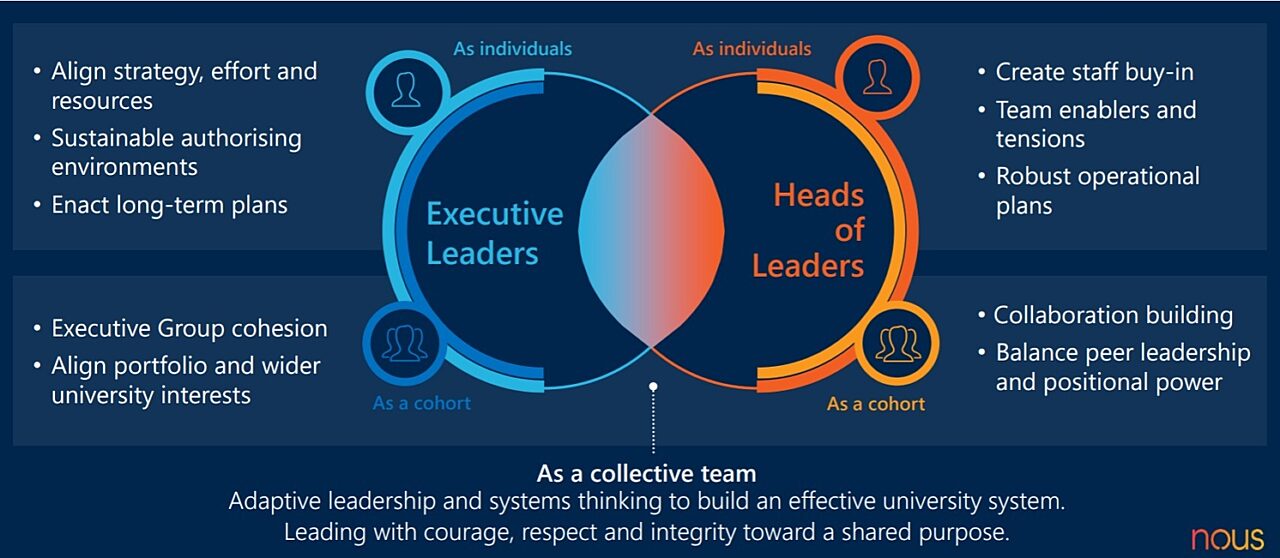
“By integrating learning and connection across both the senior leader and executive group cohorts, the opportunity was to deliver greater impact through energising growth at the individual, cohort and collective leadership levels,” says former Nous Director Ashleigh Waldby. “This was more than an isolated leadership program. It was an opportunity to invest in the university’s future success.”
Crafting a vision for leadership
The project began with the co-design of success profiles for both senior and executive leadership roles. These profiles were not so much job descriptions as articulations of the expectations of leaders and pinpointed key transition points essential for growth. By establishing a clear vision of what successful leadership looked like, the university set the stage for a comprehensive 360-degree feedback process where feedback and insights were aligned to the specific leadership behaviours identified in the success profiles as critical to performance. This process, coupled with individual debriefs, allowed leaders to identify their priority development areas, ensuring that personal growth aligned with institutional goals and collective leadership ambition.
“Co-designing the success profiles was about painting a bold picture of what leadership could be,” says Waldby. “It gave us a shared vision that inspired every step of the program, ensuring leaders were focussed on the specific behaviours required to empower their people and achieve the strategic vision.”
“What set our approach apart was the way Nous worked hand-in-hand with executives and program audience representatives, combining our unique depth of theoretical and practical leadership expertise. This collaborative and bespoke process allowed us to innovate and craft a program genuinely tailored to the University’s distinct environment, challenges and aspirations.”
Empowering senior leaders
The senior leader program was a cornerstone of the initiative, featuring a series of interactive workshops that delved into diagnosing leadership challenges and refining leadership styles. These workshops were designed to be highly practical, equipping leaders with adaptive leadership techniques. Between sessions, leaders engaged in immersion experiences, drawing inspiration from guest speakers and applying new concepts in real-world scenarios. This approach ensured that leaders were not only learning but also practising and internalising new skills. The inclusion of multiple touch-points also facilitated deep peer connections and collaboration with a cadence paced to allow to learning, application, reflection and growth.
The program’s focus on tools and frameworks for decision-making, stakeholder engagement, and task execution was particularly impactful. Leaders emerged better equipped to handle the complexities of their roles, fostering a culture of informed decision-making and effective communication.
Elevating the executive
For the executive group, the program took a an explicitly applied approach, focusing on the group defining their high-performance characteristics and co-creating a ways-of-working charter. This collaborative effort was crucial in aligning the team around shared goals and expectations. We took the step of observing a live executive group meeting, providing real-time feedback on how the team was enacting its prioritised characteristics. This hands-on approach allowed for immediate adjustments and learning.
A two-day leadership retreat further deepened the group’s development, offering a space to unpack complex challenges, build trust, and identify individual development priorities. The retreat served as a springboard for ongoing growth, supported by follow-up coaching and mentoring sessions that helped leaders embed their learning and take decisive action.
Nous offered a select panel of individual coaches and mentors from which each executive group member could choose their preferred development partner. Our coaches were selected for their deep expertise and skill in executive coaching and for their depth of experience and our mentors were selected for their extensive histories as accomplished leaders within the higher education sector. The ability for executive group members to choose the individual and style of engagement that best suited their needs was an important part of making this engagement a valuable investment for busy leaders.
Measuring success and looking forward
The outcomes of these programs were telling. Evaluation results revealed that two-thirds of senior leaders reported a shift in their leadership capability, while an impressive 91 per cent of executive members agreed that the program enhanced team performance. These numbers speak to effectiveness of the bespoke approach, highlighting how tailored development can lead to tangible improvements in leadership and team dynamics.
The success of these programs has laid a strong foundation for ongoing leadership development at the university and the insights gained continue to inform its future planning efforts. The importance of a clear vision, the value of practical, hands-on learning, and the power of collaboration cannot be overstated. Nor can that of a nuanced approach that considers the unique needs and goals of the institution and its leaders.
‘This program reinforced the importance of leadership programs being grounded in evidence but responsive to the real-world pressures leaders are facing,” says Waldby. “When design adapts to evolving contexts and real-world pressures, it unlocks impact where it matters most: helping leaders thrive and drive meaningful change.”
What you can learn from our work with Australian universities
Leaders value structured opportunities to engage with their peers, especially when they are working through complex enterprise challenges that cannot be solved in isolation. Peer problem solving creates a shared language for leadership and helps translate individual development into collective momentum.
Candid conversation and constructive challenge connects leadership theory to on-the-ground experience, making development feel practical rather than abstract. When leaders test ideas against real institutional pressures, they build the judgment and confidence needed to act differently.
Focusing on leading self, others, and the University enables leaders to reflect on the different roles they play and the skills each requires. This layered approach helps them apply nuanced leadership behaviors that respond to the specific needs of their teams, peers, and institution.