
Share Insight


Insight
At Nous, we believe in the sustaining power of great organisational leadership. Over the past two years, we have launched the Nous Leadership Way (NLW), a leadership model and development program that articulates the core principles of effective leadership at Nous. Developing NLW has prompted Managing Principal and CEO Tim Orton to think more broadly about the challenges of great leadership, the attributes of great leaders, and how we think about these at Nous.
Great leadership is too rarely defined by the ability to harness difference. But the most effective leaders are often those who actively seek out conflicting viewpoints, encourage robust debate, and create space for ideas to be constructively challenged.
To this end, Challenge is one of the tenets of the Nous Leadership Way, our organisation’s leadership model and philosophy. This tenet seeks to make the most of our diversity by encouraging (indeed insisting) leaders to challenge others’ thinking in ways that help us to reach better decisions.
Organisations' long-term success requires a culture where ideas are actively challenged
Organizations tend to make better decisions than individuals. By drawing on the collective expertise and perspectives of many people, we can outperform any single viewpoint. Consider the example from the game show Who Wants to Be a Millionaire: when contestants "ask the audience," the crowd gets the right answer more than 90 per cent of the time. There is, often, wisdom in crowds.
Harnessing diverse perspectives encourages a healthy exchange of ideas, ensures all angles of an issue are considered, fosters innovation and creativity, and generally leads to more informed decisions. Only the best ideas usually survive intense scrutiny, and no one tends to have a monopoly on the best ideas.
In lieu of omniscience, differences of opinion are invaluable.
But engaging with dissent rarely comes naturally (even from its champions)
That said, the best ideas don’t necessarily win out in debates in organisations – as the familiar metaphor of a "marketplace of ideas" would suppose. Too often, organisational hierarchies and top-down leadership approaches undermine the contexts required for honest and robust debate. When coupled with institutional inertia, fear of conflict, and deeply embedded norms of politeness, the promise of earnest enquiry can quickly devolve into groupthink or idle agreement.
To ensure divergent perspectives lead to better decisions, organisations must actively cultivate a culture where people challenge each other’s ideas. People must feel comfortable to express their thoughts even – and, indeed, especially – where this involves challenging the prevailing wisdom.
This is where leaders come in.
Leaders must create organisational cultures where ideas are challenged
Given the inevitable power dynamics that underpin and structure most workplace interactions, leaders have an important role in creating the conditions in which team members can form, voice and revise their opinions.
How this can be achieved depends considerably on an organisation’s culture and context. Some general principles that leaders should keep in mind are the following:
- Exercise emotional intelligence. Consider how team members are feeling and ensure they have the space and means to speak up, with a particular sensitivity to power dynamics.
- Set high expectations. Explicitly seek the views of everyone in the room to create the expectation that everyone contributes.
- Demonstrate intellectual humility. Many colleagues will naturally be deferential if they feel as if those in charge already have fully informed opinions. They will be much more inclined to challenge the prevailing wisdom if they feel as if leaders are genuinely forming their opinions or inclined to change their minds.
- Ensure a meritocratic approach to debate. Opinions should be judged based on their quality independent of the seniority of the person that voices them. Often the most junior colleagues will offer the most incisive analysis because they are uniquely across the details of an issue.
- Know when to make a call. Debate within teams and organisations is a means to the end of good decision-making. It can be tempting to get caught up in the intellectual exercise of debating ideas. At the end of the day, leaders need to know when debate needs to end, and a decision must be made.
Leaders should consciously play many different roles
When discussing with colleagues and clients about the value of challenging ideas, I find that many assume that the only way to do this is to be the source of disagreement. Some of us will find this uncomfortable. But there is a range of ways that leaders or organisations can realise this virtue.
To help us embody the Nous Leadership Way, we draw on the ‘Six Moves’ framework. It's an approach to collaboration that promotes a culture of constructive disagreement. We worked with Richard Boston from LeaderSpace to develop this latest iteration of his model.
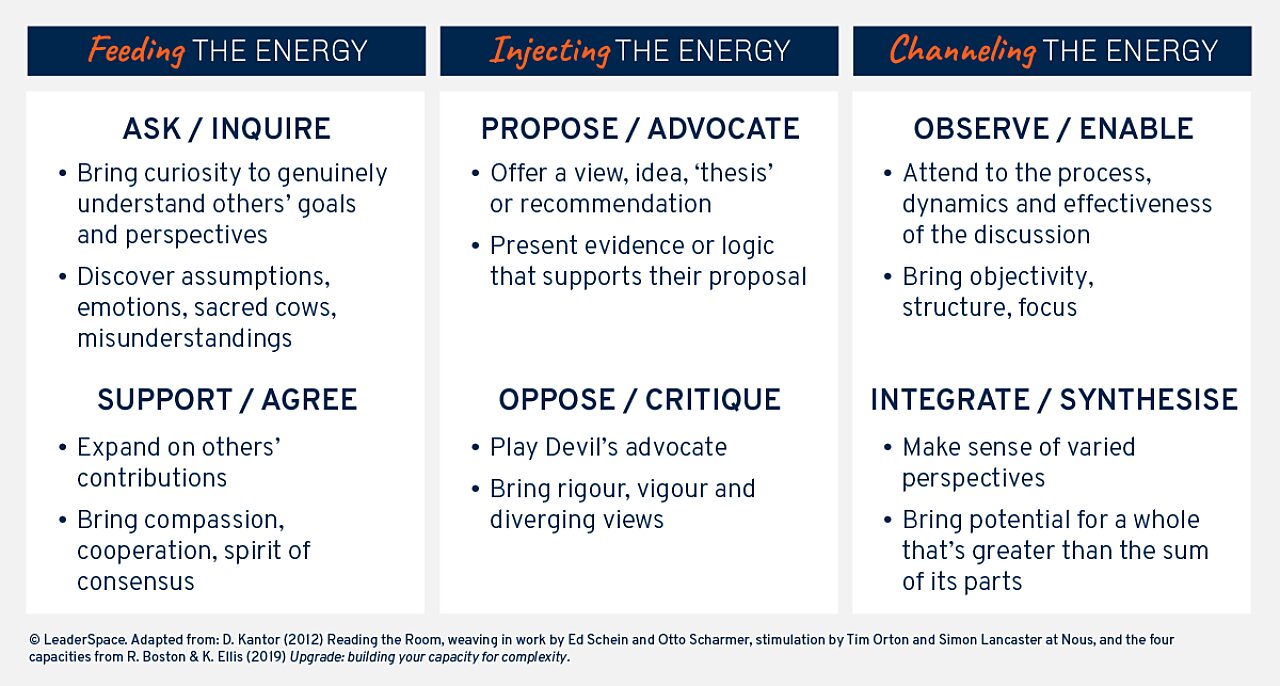
Only one of the six moves is to actively oppose or critique others’ ideas. Leaders should also seek to understand others’ views more (Ask/Inquire); build on others’ ideas (Support/Agree); throw something new into the mix (Propose/Advocate); take a step back to consider the purpose of the discussion (Observe/Enable); or offer a synthesis of competing viewpoints (Integrate/Synthesise).
Through these six moves, leaders can cultivate a culture within teams and organisations where challenging each other’s ideas is not only commonplace, but a positive, rewarding experience.
Get in touch to discuss how you can experience the full benefits of challenge in your organisation.
Connect with Tim Orton on LinkedIn.
This is the tenth article in Tim Orton's 'Exploring Great Leadership' series. It was originally posted on LinkedIn on 5 November 2025.
You can read the previous article in the series here and the next here.