
Share Insight


Idea In Brief
Access is great, but it isn't enough
Universities will be judged by whether students progress and complete, not just by whether more diverse cohorts are admitted.
Student risk emerges earlier than institutions often see it
Traditional surveys and retrospective data can identify patterns, but they rarely help universities intervene while students are still deciding whether to stay.
Real-time student voice should become core infrastructure
Timely, purposeful feedback can help leaders connect student experience to decisions about teaching, support, investment and completion outcomes.
Australian higher education has spent decades widening access, and while we have made some progress, there is still a way to go before we achieve the targets recently set by the Australian Universities Accord. But the next test of equity will not be measured only by who gets in. It will be measured by who progresses, who completes, and whether universities can see and respond to emerging student risk early enough to make a difference.
The Accord has made this shift more urgent. Its reform agenda places equity, participation, and attainment at the centre of the sector’s future, including the ambition for more Australians to hold tertiary qualifications over coming decades. That makes student success a strategic operating challenge for universities, and not a peripheral student services issue.
For Vice-Chancellors, Provosts, Deputy Vice-Chancellors, and other senior leaders, the question is becoming more practical and more difficult: are current teaching, support and feedback systems capable of helping a more diverse student body succeed, or are they still organised around late signals, fragmented services, and students self-identifying after the window for effective intervention has begun to close?
Access without completion can deepen disadvantage
A student who is admitted to university but not supported to succeed may end up worse off than if they had never enrolled. They may have accumulated debt, lost time, experienced a blow to confidence, and emerged without the credential that would improve their employment prospects. For students who already face financial, cultural, academic or personal barriers, non-completion can compound disadvantage rather than reduce it.
Public data already points to persistent differences in retention, success and completion across equity groups. The Australian Centre for Student Equity and Success tracks access, participation, retention, success and six- and nine-year completion outcomes for key equity groups, while Department of Education data provides national attrition, success and retention tables. The data shows that, while we have made some progress on widening participation, equity groups remain less likely to succeed, and the gap in some cases is widening. Across equity groups, success rates are between 2.7 to nearly 10 percent less than their domestic peers, and students from remote locations are less likely to succeed today than they were ten years ago. Most notably, as demonstrated in the figure below, the greater participation, generally the lower success rate. The message is clear: participation growth alone does not guarantee equivalent outcomes.
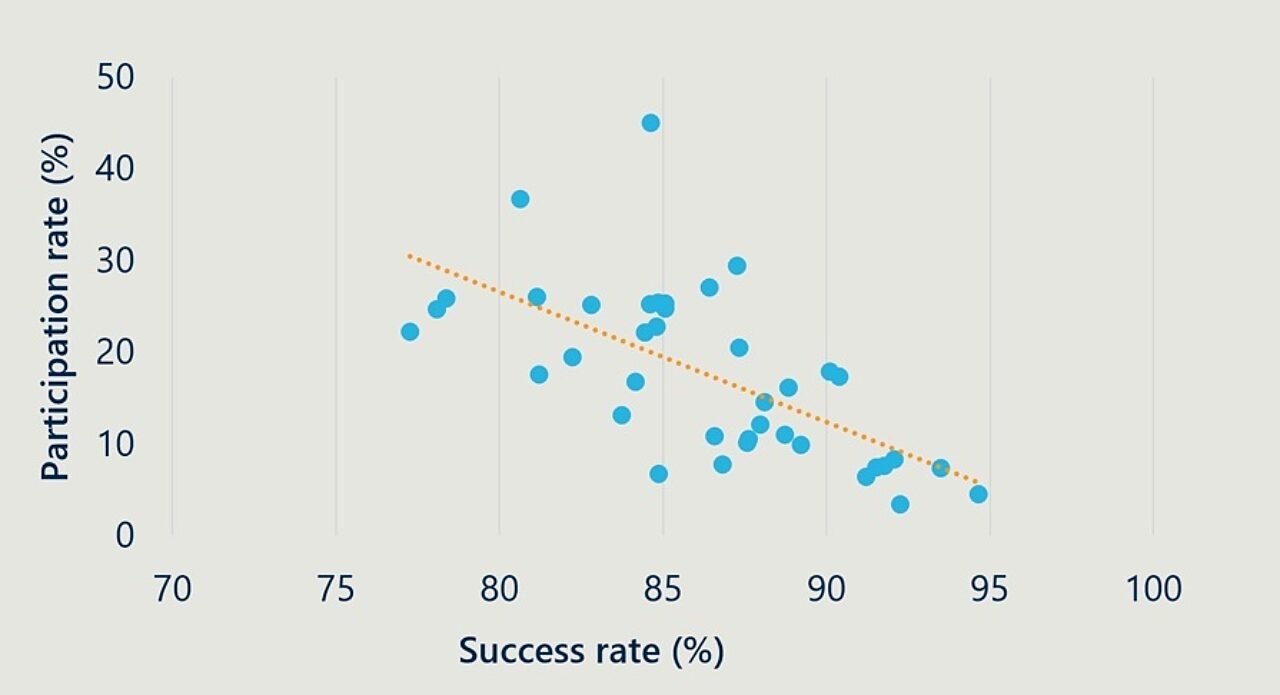
The institutional case is just as strong as the moral one. Retention is no longer a peripheral student services issue. Every student who leaves represents a human cost and a financial cost. In a constrained funding environment, universities cannot treat student success as an optional add-on or assume recruitment will compensate for preventable attrition. Retention is becoming the new recruitment: keeping students is cheaper, fairer, and more sustainable than continually replacing them.
The problem isn't commitment, but timing
Most universities are deeply committed to student success. Many have made substantial investments in academic skills, counselling, disability support, financial assistance, transition programs, learning analytics and student experience teams. Yet students still fall through the cracks because institutional systems too often see risk after it has already become difficult to reverse.
End-of-semester surveys, annual experience measures and aggregate demographic reporting are useful, but they are largely retrospective. They can inform next year’s improvement agenda, but they rarely help the student who is confused in week three, overwhelmed in week five, disengaging before census date or considering withdrawal, before anyone has asked the right question.
Universities do not lack data, they lack timely, granular and actionable student voice that is connected to decisions about teaching, support and progression while intervention is still possible.
Progression and completion require earlier signals
The next generation of student success work needs to focus less on whether support exists and more on whether universities can identify need early, understand what is driving it and respond at the right level. That is a broader executive challenge than student services alone, because the need may relate to anything from course design to the need for more peer engagement.
For some students, the barrier may be assessment confidence. For others, it may be belonging, financial pressure, unclear expectations, timetable constraints, inconsistent teaching practice, placement load, cultural safety, wellbeing or uncertainty about where to seek help. The common point is that their experience changes during the semester, and many of the most important signals emerge well before traditional institutional measures detect them.
We must also recognise that both the level of attrition and reasons for disengagement vary across cohorts. According to a recently released report from the Australian Centre for Student Equity and Success (ACSES), retention after the first year of study has increased overall in Australia, but there is still a considerable gap between equity and non-equity students, and there are considerable differences across equity groups. The retention rate was only 75% for First Nations students and 84% for students with disability, compared with 88% for non-equity students. Successful intervention requires early signals about what is driving attrition for each university’s unique student populations.
The leadership question is therefore not simply “do we have support services?”. Most universities do. The sharper question is whether the institution can see emerging student risk early enough, understand the cause and coordinate the right response before disadvantage becomes failure, withdrawal or lost progression.
Real-time student voice should become core student success infrastructure
Real-time feedback changes the purpose of listening. Instead of treating student voice primarily as evaluation after the fact, it turns listening into a live input to improvement and intervention. Short, well-timed prompts can help teaching teams, support teams and institutional leaders understand whether students are confused, overloaded, disengaged, lacking confidence or unsure where to go for help.
That does not mean surveying students constantly or replacing human judgement with dashboards. The point is to design light-touch, purposeful feedback loops that ask the right questions at the right moments and connect the answers to people who can act. The value is not in more data. It is in earlier insight, clearer prioritisation and faster response.
Student voice needs to support executive decisions, not just local improvements
Real-time feedback is often framed as a teaching or student services tool. It is more than that. For senior leaders, it can provide a sharper view of whether institutional strategy is reaching students in practice. It can show whether first-year transition is working, whether support is visible, whether students understand academic expectations, whether particular cohorts or disciplines are experiencing different barriers, and whether interventions are changing the lived experience of students.
That matters because completion and progression are not owned by a single portfolio. They sit across academic leadership, student experience, data and analytics, wellbeing, equity, finance and operations. A fragmented view of student voice produces fragmented action. A more integrated view can help universities make better decisions about where to target support, where to redesign courses, where to invest in advising and where student risk is systemic rather than individual.
The cost of waiting is rising
The hidden cost of slow student voice is that universities learn too late. They learn after the student has failed an assessment, withdrawn from a subject, missed too many classes, disengaged from peers or decided that university is not for them. By then, intervention is still possible, but it is harder, more expensive and less likely to repair the full damage. If it goes unresolved, and disengagement becomes attrition, the revenue implications can be dire. Just a one per cent increase in attrition can cost a mid-sized Australian university $15 million annually.
The cost is not only financial. It is also a loss of confidence, belonging and trust. For students from underrepresented groups, late institutional response can reinforce the belief that they are the problem, rather than signalling that the institution is organised to understand and support their success.
For universities, the cost of waiting shows up in progression rates, completion outcomes, reputational risk, inefficient support investment and lost revenue from avoidable attrition. In the Accord environment, where access, equity and attainment are becoming more central to public policy, these outcomes will attract more scrutiny, not less.
The only listening that matters is listening that changes outcomes
Universities already ask students many questions. The challenge is whether those questions are timely, whether they generate actionable insight and whether the institution has clear accountabilities for response. A student voice system that produces reports but does not change decisions will not improve completion. A system that helps leaders, teachers and support teams understand where students are struggling while there is still time to act can become part of the institution’s student success infrastructure.
Nous Data Insights’ StudentSense is one way to build that capability. It helps universities listen earlier and more purposefully, identify patterns across cohorts and contexts, and translate student feedback into practical action. Its value is not that it replaces existing student success strategies, but that it gives those strategies a clearer, more current view of student experience.
The access agenda opened the door. The success agenda asks whether universities are organised to help students get through it. For senior leaders, the practical starting point is to understand what their current feedback mechanisms already reveal, where the most important gaps sit, and whether they are hearing from students early enough to shape progression and completion outcomes while action is still possible. Nous Data Insights can support a focused diagnostic conversation to help clarify where your institution stands today, what a more actionable student voice model would require, and what a practical path forward looks like.
Get in touch to discuss how real-time student voice can help your institution identify student risk, strengthen progression and completion outcomes, and turn feedback into action while there is still time to make a difference.
Connect with Mia Juritzen on LinkedIn.