Share Insight


Idea In Brief
Army’s littoral advantage depends on adaptable people and culture
Leaders must connect across organisational boundaries, support workforce resilience and make continual learning part of how Army operates.
An integrated operating model must support sustained performance
Clear accountabilities, coordinated decisions and connected support functions are essential to keeping people, technologies and partners working together over time.
Infrastructure and sustainment must be designed as a connected network from the outset
Ports, maintenance facilities, supply chains and community partnerships must evolve together to sustain littoral capability over decades.
Army’s investment in littoral platforms will only create strategic advantage if its people, operating model, infrastructure and partners evolve with them.
The littorals are where the sea, land, air, space and cyber domains converge. They include coastal waters, land, rivers, airspace, infrastructure, communities, the electromagnetic spectrum, and the space above them. They are central to Australia’s security and prosperity: most Australians live near the coast, almost all international trade passes through coastal waters and shipping lanes, and critical internet cables reach the country through these zones.
Army has always possessed a littoral capability. What is changing is its scale, reach, and strategic importance. New landing craft, long-range strike, armoured fighting vehicles, drones, communications, and battlespace management systems will create new possibilities in an increasingly connected environment. But platforms do not create advantage by themselves. Advantage emerges when people, organisations and partners can collaborate to create a coherent eco-system that performs under pressure.
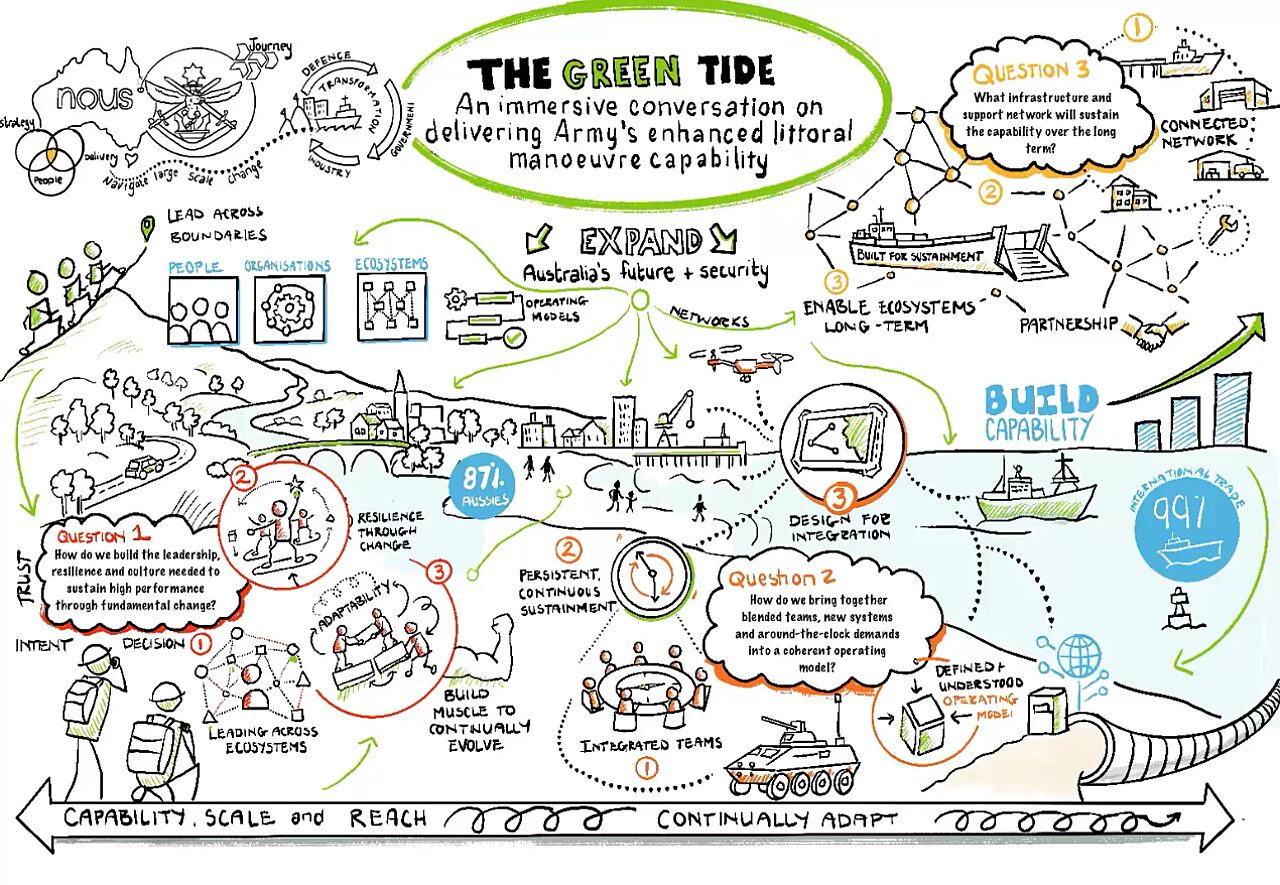
Enhanced littoral manoeuvre should therefore be approached as a whole-of-system transformation, not just a capability acquisition. Defence must address three connected priorities: how to develop people who can perform through continual change and build a culture that continually evolves, how to design an operating model for integrated and persistent operations, and how to build the infrastructure and support network that will sustain the capability into the future.
Develop people and culture for continual adaptation
Future advantage will not come from vessels alone. Platforms, systems, and infrastructure become capability through leaders who can connect across boundaries, people who can adapt, and a culture that treats continual evolution as normal.
Develop leaders at all levels who can integrate people across boundaries
Littoral manoeuvre is inherently Joint, that is, it involves all three Services working seamlessly together. It will also depend on close collaboration with allies, industry, governments, and communities. Leaders will need to create shared intent across different structures, accountabilities and ways of working.
Command authority and domain expertise remain essential, but they are no longer sufficient. Leaders must also be able to build trust quickly, make decisions with incomplete information, challenge established assumptions and enable people across the ecosystem to learn their way through unfamiliar problems. This requires adaptive leadership skills: the ability to distinguish between challenges that can be resolved through existing expertise and those that demand experimentation, collaboration and changes in behaviour. Building these skills deliberately—through realistic joint experiences, reflection, feedback and practice—will enable leaders to maintain operational discipline while continually adapting how the system works.
Enable a workforce that can thrive through uncertainty
A resilient workforce is one that is equipped to perform while change is happening, not merely endure disruption until conditions settle. New technologies, operating concepts and partnerships will continue to emerge. People therefore need clarity about what matters, the skills and support to respond, and leaders who help teams learn quickly, recover quickly and keep improving while the environment shifts.
Enabling this resilience requires deliberate investment in workforce development and wellbeing. By strengthening adaptability, fostering collaboration and creating opportunities for reflection and growth, Army can build a workforce capable of responding confidently to uncertainty and complexity. Such a workforce is not only able to absorb disruption and sustain performance under pressure, but is also positioned to identify opportunities, accelerate innovation and maintain operational readiness in the face of ongoing change.
Make continual adaptation part of Army’s DNA
Enhanced littoral manoeuvre is not a transformation with a clean end date. It is a lasting shift in how Army thinks, operates, partners and sustains capability.
Culture is therefore a capability issue. Army will need to create the organisational conditions in which people can test assumptions, share lessons and adapt approaches without losing strategic direction or operational discipline. The objective should be to build the organisational muscle to keep evolving as strategy, technology and mission demands change.
Design an integrated operating model for persistent operations
A well-defined and widely understood operating model turns capability into performance. It translates ambition into the practical architecture of delivery: how teams work together, how decisions are made, how information moves, where accountability sits, how risk is managed and who can accept it, and how the system continues to operate under pressure.
Design around the mission
Integrated operations cannot be designed around organisational boundaries. Each boundary otherwise becomes a handover, a delay or a source of ambiguity.
Designing around the mission prompts more useful questions: Who needs to be involved? What decisions must be made? Who has authority and accountability, and how will the right information reach the right people at the right time?
Integration does not mean blurring responsibility. Complex systems need greater clarity, not less. Roles, decision rights, escalation pathways, and coordination mechanisms must be explicit enough to support rapid action without creating unnecessary control.
Design for persistence
Much of Army’s operating model has historically focused on generating and deploying force elements. Future littoral capability adds larger and more complex vessels, longer-duration activity, continuous sustainment, new crewing arrangements, and the prospect of around-the-clock operations.
These demands change how workforce, maintenance, training, rostering, fatigue management, and support functions must be designed. The test is not only whether the capability can deploy, but whether it can keep operating, learning, and improving.
Workforce availability, maintenance cycles, supply chains, infrastructure, digital systems, decision forums and partner contributions must be designed together rather than held together by individual effort and workarounds. A capability can appear strong on paper yet prove fragile if its operating model cannot sustain the people and systems behind it.
Design for persistence
Multiple new capabilities are arriving across the Services at the same time. Their value will not be determined by how well each performs in isolation, but by whether they function as a single fighting system.
The operating model must connect people, technologies and partners while clarifying how information is shared, decisions are synchronised, risks are managed and technical systems support human judgement.
This is where transformations often succeed or fail. Investment in new systems will produce diluted benefits if the organisation remains fragmented. People work around systems, teams invent local processes, and decisions slow down. A mission-led, integrated operating model is what converts a collection of assets into reliable operational performance.
Build a resilient infrastructure and support network
If the operating model turns capability into performance, infrastructure and support allow that performance to endure. Future littoral operations will depend on an integrated network of ports, training areas, maintenance facilities, logistics hubs, accommodation, supply chains, and support services. Its strength will be determined not by any one site, but by how effectively people, equipment, maintenance activity, training access, and information move across the system.
The design question should therefore move beyond what an individual base needs to what the whole network needs to perform. That shift creates flexibility, redundancy and resilience.
Make sustainment a front-end principle
Acquiring platforms is only the beginning. Larger vessels and more complex systems place greater demands on maintenance, logistics, workforce, training and supply chains. Persistent operations increase pressure on people, facilities and partners.
If sustainment is deferred until after acquisition, a capability that impresses at introduction may be difficult to maintain. Army’s operational knowledge must inform design from the outset.
Build an ecosystem, not only an estate
The capability network extends beyond the base gate to ports, roads, housing, workforce markets, training providers, shipyards, contractors, digital providers, suppliers, and local communities.
Industry capacity, state infrastructure priorities, workforce availability, and community support will shape what can be generated and sustained in practice. Partnership is therefore not an adjunct to capability delivery. It is part of the capability itself.
A fit-for-purpose base network must be understood as a connected, sustainable and resilient ecosystem that can generate, sustain and scale littoral manoeuvre over decades.
The system must move together
Enhanced littoral manoeuvre offers Army an opportunity to strengthen a capability critically important to Australia’s security and prosperity. Realising that opportunity demands more than acquiring vessels. It means developing leaders across all levels who can work across boundaries, supporting people to perform through uncertainty, creating operating models that unite teams and technologies, and building a resilient network of infrastructure and partners.
Army has always adapted, but the scale and nature of this change are distinctive. Integration across Services, persistent operations and increasingly complex maritime and industrial programs cannot be delivered by Army alone. Government, industry, partners and communities all shape the conditions for success.
Army’s littoral advantage will not be determined by the vessels it acquires, but by how effectively it mobilises the system around them. The green tide will succeed when people, operations, infrastructure and partners can learn, adapt and perform as one capability.
Get in touch to discuss how we can help align your people, operating model and partnerships to turn capability investment into lasting advantage.
Connect with Dr Kelly Samson on LinkedIn. This piece was co-written with RADM (Ret’d) Tony Dalton, AM, CSM.