Share Insight


Idea In Brief
Research excellence depends on capability
Universities must develop researchers’ thinking, feeling, and doing capabilities if they want talent to translate intelligence into sustained impact.
Culture determines high performance
Even highly skilled researchers can underperform in environments that constrain confidence, creativity, and exchange.
Future-ready research requires translation
Researchers need agility, interdisciplinarity, and practical communication skills to render knowledge something truly valuable.
In my work with research leaders and institutions, I frequently explore the thinking, doing, and feeling capabilities that are foundational to unleashing the productivity of our researchers, particularly those in roles that are about enabling and leading others. As Amartya Sen conceives them, these are the capabilities that expand the freedoms and agency of an individual, and the way these interact with the wider environment in which an individual or community is situated. It is these interactions that determine how well a capability can help realise an individual or community’s potential, or, in this context, how well a researcher or research team can be high performing and realise impact.
The thinking-feeling-doing researcher
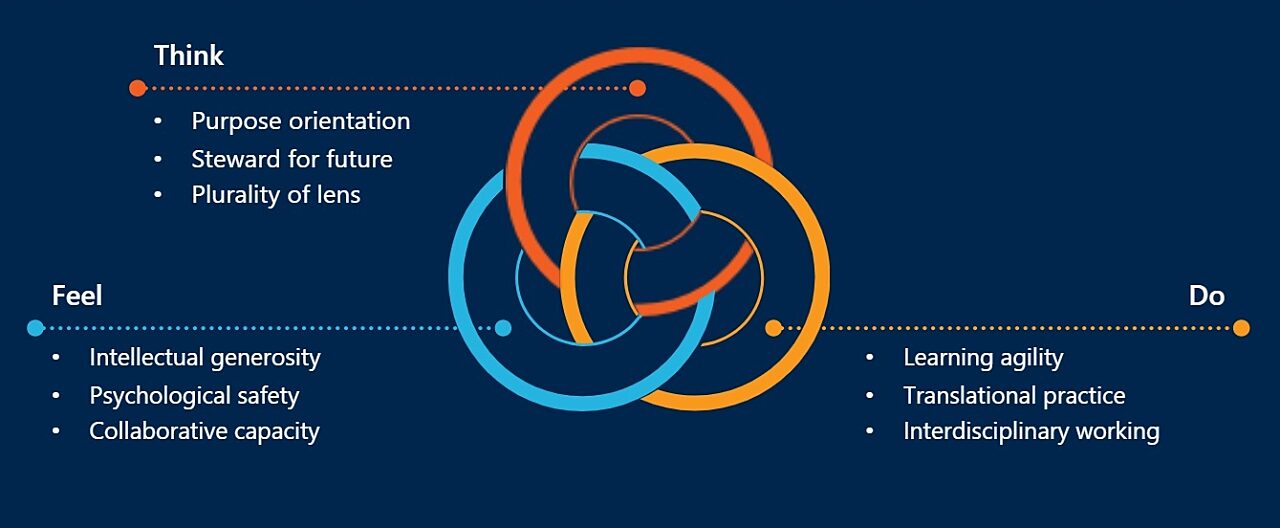
Building on the findings of a multi-year empirical study investigating the experiences of Indian researchers working across a range of disciplines, and iterating this with our global network of research leaders and research teams on the journey towards high-performance, I have identified the core capabilities in which researchers can do their best work and sustain intellectual ambition.
Thinking capabilities: To know thyself and the world
Purpose orientation
Purpose provides direction and motivation for researchers. The strongest research environments are those that connect individual research endeavours to larger economic, social, national and global agendas. Purpose provides shelter against the immediate, daily pressures of academic life and builds up the resilience of researchers to withstand setbacks and failures.
The most productive, high-performing researchers often tell us they want their research to matter, as something that change lives and addresses community challenges in the long term. In an increasingly complex regulatory and financial environment, the challenge is to create the conditions where researchers continuously encounter their purpose and are supported to work without interference.
Steward for the future
My research demonstrates that a powerful indicator of research performance is the role that formal and informal individuals play in enabling and encouraging others to make breakthroughs. This takes place at multiple levels: that of discipline, of university or organisation, and of the wider community, with industry and community networks. Stewarding activities include mentoring, facilitating connections, accessing resources, building support, coalitions and awareness around new research areas. Stewarding is a form of leadership, but it is not confined alone to leaders of research teams and in formal positions. Post-docs, supervisors, professional services staff involved in supporting research activities among others all have a role in stewarding towards new scientific frontiers. While there are disciplinary variations, in that some fields are inclined towards team working and others where scholarly pursuit is an individual activity, stewardship leads us to imagine research ultimately as a collective endeavour.
Plurality of lenses
We should be cautious of arriving at any one prescriptive model of research excellence or a way of doing things. Research is outcome driven but those outcomes are many and varied.
Different disciplines operate according to different logics. Institutions possess distinct capabilities. Diverse forms of knowledge create and reshape society in different aways. Through policy, regulation and practice, attempting to impose a uniform model risk undermining the very diversity that fuels innovations.
This is why high-performing researchers, teams and organisations are those that embrace the ambiguity and possibility that comes with plurality of ideologies, approaches and innovations. It is a way of seeing the world that continuously seeks new answers where we are never fully satisfied with the status quo.
Feeling capabilities: We make the world anew though others
Intellectual generosity
Across each of the disciplines that were a focus of my study, I observed that knowledge only true advances through exchange.
Intellectual generosity comes in the form of reviewing work, sharing expertise and transferring skills and networks. Where generosity is absent, capability concentrated in individuals and can disappear as people and ideas move on. Where it flourishes, capability and knowledge are embedded within institutions, disciplinary communities and innovations. Intellectual generosity is a structured practice and cannot be left to the whim of individuals and teams. In our work developing the capability of individuals and institutions, we apply immersive exercises and tools that build the muscle of intellectual generosity in a structured way.
Psychological safety
Researchers do their best work when they feel safe to explore difficult questions, challenge prevailing assumptions, and learn from failure. Failure is part and parcel of the research endeavour. My research consistently highlighted the importance of supportive peer relationships, effective supervision, and environments where research seek advice and feedback.
Psychological safety is not just built through in-person experiences. Computer science post-docs told me about the value of online forums where they could connect with peers at a global level. They frequently described the experiences of trusted colleagues who shared knowledge and lessons learned. Research teams and institutions that aspire to world-class excellence must cultivate cultures where curiosity is encouraged and mistakes become opportunities for ongoing learning.
Collaborative capacity
When we think of a leading researcher or scientist, our minds still likely conjure images of Einstein working for long hours in a laboratory. But this seemingly enduring image is increasingly inaccurate. In the context of my research, for example, computer science researchers in India are tightly networked within a global ecosystem and with industry including in Silicon Valley.
There are many rings of collaboration, within discipline, with industry, and within immediate project and laboratory teams. Research increasingly depends on the ability to work across specialisations, contribute to collective endeavours and integrate diverse forms of expertise. Even where individual scholarship remains important, it is often supported by collaborative communities of practice. In a world where research challenges are becoming more complex, collaborative capacity is almost as important as sheer intellectual talent.
Doing capabilities: Do what you say and say what you do
Learning agility
Researchers are constantly adapting to new technologies, methodologies, funding expectations and areas of inquiry. Researchers frequently told me about the importance of learning new techniques, adopting unfamiliar approaches, and responding to changing conditions. The highest-performing researchers demonstrated what might be described as learning agility: a willingness to continuously acquire new knowledge and adapt existing expertise to emerging challenges.
Future research leaders will need to become less dependent on static bodies of knowledge and more capable of learning quickly in rapidly changing environments. This includes working with AI, which is profoundly reshaping so many aspects of research.
Translational capability
An increasingly important differentiator of research excellence, and in turn the capabilities of researchers is their ability to translate research into wider contribution. Stakeholder management skills, influencing and communication, entrepreneurship, systems thinking and partnership development support researchers in their efforts towards practical impact, develop innovations, and ultimately address societal challenges.
Traditional approaches to researcher development emphasise knowledge creation. In our work with leaders across a range of sectors and contexts, Nous emphasises knowledge and skill application. Adaptability and entrepreneurialism will become the defining characteristics of high-performing researchers in the coming decades.
Interdisciplinary openness
The increasingly VUCA world in which we live – which is to say volatile, uncertain, complex and ambiguous – demands interdisciplinary approaches. Addressing the impacts of climate change are as much environmental as they are economical and sociological.
Researchers increasingly note the importance of interdisciplinary collaboration and engagement with different ways of knowing. However, genuine interdisciplinarity requires more than structural arrangements. It requires cultural openness to alternative perspectives, methodologies and traditions.
Building capability-rich research cultures matters
The challenge for universities is not simply to build better researchers. It is to build capability-rich research cultures.
Developing researchers’ thinking, feeling, and doing capabilities in the ways described above requires a fundamental transformation. Institutions and teams seeking to build research capability should focus less on isolated training programs and more on creating developmental environments. The most effective research cultures are those that provide opportunities for researchers to practice and reflect on their own capabilities.
Highly capable researchers can still underperform when hemmed in by cultures that inhibit creativity, discourage collaboration, and undermine intellectual confidence. The most powerful finding from my research is that excellence emerges from the interaction between individual capability and collective culture.
Get in touch to discuss how your institution can build the capabilities, cultures, and conditions researchers need to do their best work.
Connect with Dr. Minto Felix on LinkedIn.