
Share Insight


Idea In Brief
Researchers belong at the centre of research finance service design
Designing clear pre‑ and post‑award processes means that researchers can understand their financial position quickly and spend less time navigating administrative complexity.
Use existing technology and automation before buying expensive systems
AI tools and workflow automation can improve visibility accuracy and experience without disruptive replacements.
Service culture matters more than reporting lines
Performance monitoring and positive researcher engagement is key to building trust and accountability.
It’s the end of the fiscal year. A PI wants to hire a postdoctoral fellow to support a promising line of inquiry, but they can’t get a clear answer on whether the funds are actually available. One report shows a surplus, another suggests a shortfall, and a third, maintained in a personal spreadsheet, is the only one they trust. Hours are lost reconciling numbers instead of advancing research. Decisions are delayed, talent is missed, and momentum stalls.
This experience is far from unique and it captures the day‑to‑day reality of research finance at many universities.
Research finance is a persistent challenge for many universities
Globally, universities grapple with delivering research finance (pre- and post-award financial management) in ways that satisfy researchers, comply with granting agencies, and maintain robust financial controls. Most institutions rely on general finance systems or their ERPs to manage research finance. Yet these platforms often struggle with the unique requirements of grant reporting, tax, and the nuanced needs of research projects.
The result? A fragmented, cumbersome experience for both researchers and administrative staff. The market for research finance-specific systems remains limited, and those who have explored these solutions often find them prohibitively expensive, in terms of both dollars and staff time. As a result, universities are seeking practical ways to bridge the gap without incurring unsustainable costs.
Canadian funding sources drive added complexity
Research finance is complex everywhere but there are features of the Canadian context that make it particularly challenging to manage within general finance systems. Tri‑Agency funding comes with detailed and evolving eligibility rules that require careful interpretation and consistent application across institutions. Research grants rarely align neatly with institutional fiscal years, academic calendars, or hiring cycles, making it harder to forecast commitments and manage cash flow with confidence. Payroll in particular presents challenges, as institutions navigate distinctions between employees, trainees, fellows, and students each with different tax and reporting implications. These nuances often force institutions into manual workarounds or parallel tracking just to ensure compliance.
It’s never been a better time to make your institution attractive to researchers
The recent federal budget signals historic support for research, with major investments in AI and quantum infrastructure, a $1.7B global talent attraction strategy, and new funding to accelerate commercialization across health, aerospace, and life sciences. But attracting talent depends on more than funding alone. Institutions must be able to onboard grants quickly and manage research funds with clarity and confidence. When research finance systems lag, they become bottlenecks, slowing research, frustrating new hires, and undermining institutional reputation. In this environment, research finance isn’t just back office; it’s a core part of the research value proposition
What we hear from the sector
We often joke that some of the most difficult dangerous conversations at a university are between researchers and accountants. More often that not it’s an issue of translation, the PI needs timely info and the complex made simple, while the Research Accountant is focused on compliance, where the consequences on non-compliance can be substantial for the institution.
Regardless of the cause, the pain points are real:
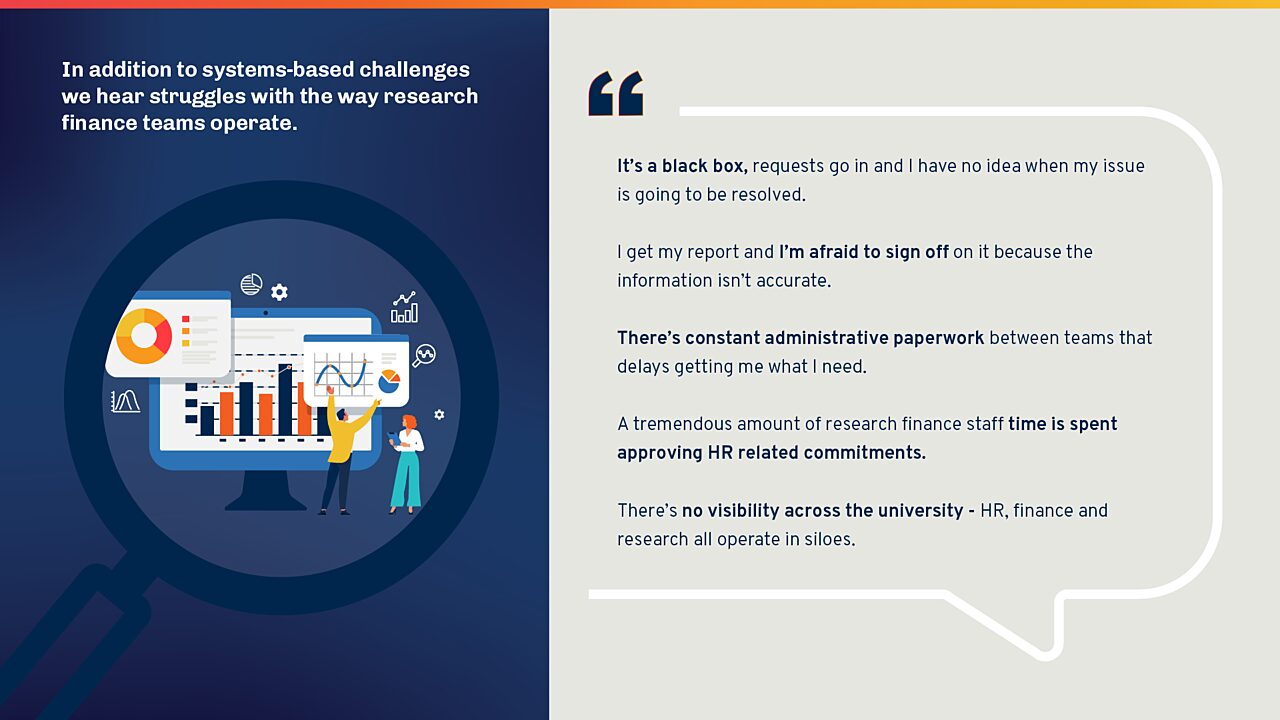
- Researchers often find it difficult to access real-time grant data, especially future payroll commitments, and lack self-service tools for managing their finances.
- Key financial information is siloed, requiring manual workarounds and double entry, which leads to errors and forces researchers to keep their own records.
These issues have real consequences:
- Researchers lose confidence in institutional data and become more risk‑averse delaying hires or underspending grants to avoid errors.
- Finance and research administration staff spend disproportionate time reconciling discrepancies instead of providing value‑added support.
Over time, this erodes trust between researchers and administrators and contributes to burnout on both sides of the relationship.
A bigger issue: Locked-in systems and missed opportunities
These challenges point to a broader problem: many universities are locked into ERPs that don’t flex to specialized needs like research finance or where they do the cost is prohibitive for most institutions. There’s a clear opportunity to explore modular approaches, integrating targeted solutions with existing systems, avoiding vendor lock-in, and giving institutions greater control and adaptability.
Moving the location of your research finance team won’t solve the underlying issues
Universities often assume the solution lies in organizational realignment. If research finance sits in central Finance, the instinct is to move it under the Vice President Research. If it sits within the research portfolio, the pull is toward centralization. While governance and reporting lines matter, moving the location of the team won’t address the root causes of these challenges. Poor user experience, lack of visibility, and inefficient processes persist regardless of where the team reports.
There are three key things to focus on to improve the performance of research finance
- Put the researcher at the centre of your service design to ensure they can focus more of their time on research and less on the administrative burden associated with it. Take the time to design an end-to-end institutional approach to the pre-and-post award research life cycle. Establish clear access pathways and service standards for researchers so they know where to go and what to expect.
- Make the most of your current technology through AI and Automation rather than adopting new systems entirely. In working with clients, we’ve discovered that a lot can be done with CoPilot, PowerAutomate and Excel. In addition, within current systems there are often adjustments that can be made to improve the user and service deliverer experience.
- Create a culture of service orientation within your research finance team. Explore the use of ticketing to increase accountability, provide metrics on performance and give researchers more self-service options. Create forums where research finance teams meet regularly with researchers to understand what’s working well and what isn’t.
Research finance doesn’t need to be a source of friction and improving it doesn’t require a wholesale system replacement or a disruptive reorganization. With the right design choices, tools, and mindset, it can become a strategic enabler, helping institutions move faster, attract talent, and make better use of research funding. As competition for research funding and talent intensifies, universities that treat research finance as a core capability, not just an administrative necessity, will be better positioned to succeed. Getting this right is not just about managing dollars; it’s about enabling research to move faster, go further, and deliver greater value.
Get in touch to discuss how you can transform research finance into a core capability.
Connect with Jordan Lazarus and Lexi Kilmartin on LinkedIn.