
Share Insight


Idea In Brief
Capacity alone will not fix Canada's fragmented apprenticeship system
Employers, colleges, and apprenticeship authorities each hold part of the picture, so no one is accountable when an apprentice changes employer, misses an intake or never books the exam.
Colleges and polytechnics can provide continuity without owning the journey
With contact, regional reach, and reporting to government, they are well placed to treat apprentices as their own for the whole journey, not just the eight weeks of a training block.
A few dependable connections will do more than a new program
Starting every apprentice with a three-way training plan and agreeing what happens when work is disrupted can help target the points where momentum is lost.
From 16 November, anyone who has certified in a Red Seal trade since April 2025 can apply for a $5,000 completion bonus. It is a small item in a large plan, but it shows that federal attention is increasing focus on how many apprentices finish, not just how many start.
The plan is ambitious. The 2026 Spring Economic Update proposed up to $6 billion over five years for Team Canada Strong, with the goal of cutting the path to certification by half. The initiative aims to recruit, train and hire between 80,000 and 100,000 new Red Seal workers. Its largest single stream, $3.4 billion, targets the challenges that stop apprentices completing their training and moving into permanent jobs. Announcements since then have added $2 billion for provinces and territories and more than $430 million for union-run training centres.
The scale of the challenge warrants that ambition. Among apprentices who had reached the expected duration of their program, about one in five had certified, nearly half were still registered, and almost a third had discontinued.
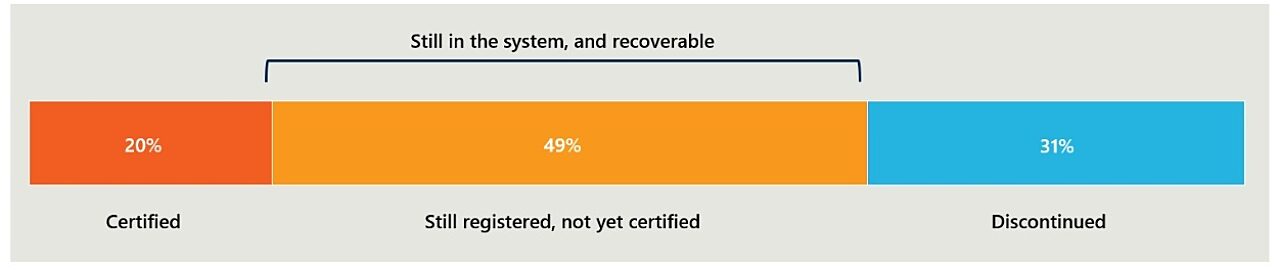
This does not mean four in five apprentices will never certify. It does mean that most have not certified when they should have, and that a large group remains in the system and could still be supported to finish. Our colleagues Hamish Ride and Nathalie Mejia set out the wider evidence in 'Is information the missing ingredient for apprenticeship success?' That piece argued that Canada needs better information to see where apprentices stall. Here we explore what colleges and polytechnics can do with that information.
New money will add capacity, but it is unlikely to fix a fragmented journey
Most of the new investment adds capacity through more training seats, more employer incentives, more income support, and faster digital logbooks and exams. These address real barriers, but capacity alone does not fix the structure an apprentice moves through.
Responsibility for the apprentice is divided. Employers see attendance and performance on the job, colleges see participation and results in technical training, and apprenticeship authorities see registration, hours and certification status. Each holds part of the picture, but no one is clearly accountable for the whole. As a result, an apprentice can change employer, miss an intake, fall behind on hours, or finish technical training and never book the certification exam, without triggering a coordinated response.
These handoffs are where momentum is lost. Employment change is one of the most common reasons apprentices leave, and losing an employer is a sudden stop. Slower drifts can do as much damage, such as an intake deferred because the employer cannot release the apprentice, or a final exam that never gets scheduled. Without a better way to manage these handoffs, new investment risks adding to the number of apprentices who stall, rather than the number who certify.
Part of the problem is cultural. Many institutions treat apprentices as their students for the eight or ten weeks of a technical training block. Between blocks, the apprentice is the responsibility of the employer, or to no one. This is understandable given how institutions are funded, but it sits increasingly at odds with a system that now rewards certification.
Colleges and polytechnics can provide continuity without owning the journey
We are not arguing that colleges and polytechnics should own the apprenticeship journey. Employers remain the primary place of learning, and apprenticeship authorities remain responsible for registration and certification, and institutions cannot direct either.
What they can provide is continuity. A college sees the same apprentice several times over three or four years, works with dozens of employers across a region and already reports to government on training. Few other parties in the system combine that repeated contact, regional reach and existing accountability.
The shift is from serving apprentices during training blocks to treating them as the institution’s apprentices for the whole journey, even when they are not in the classroom.
Where institutions have made this shift, they have not sought to take over the system. Instead, they have focused on two things: understanding where apprentices lose momentum, and strengthening a few critical connections across the journey.
Understanding where apprentices lose momentum comes first
The first step is to see the journey as the apprentice experiences it, rather than as each organization’s systems record it. A high-level journey map is enough to start, showing where apprentices stall, who holds the relevant information at each point, and where the institution could step in or coordinate support.
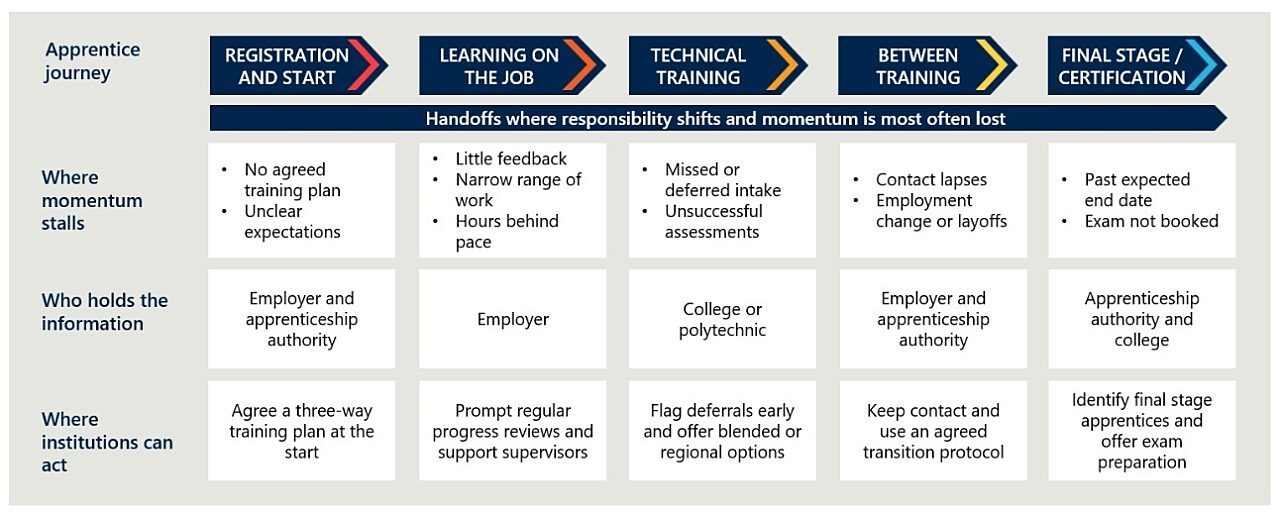
The map also points to the leading indicators worth watching. The most useful are practical and observable:
- No active sponsoring employer, or a recent change of employer
- A missed or deferred intake
- Hours or competencies behind the expected pace
- No documented training plan or recent progress discussion
- Repeated unsuccessful assessments or a long break in learning
- An apprentice past the expected end date or finished training with no exam booked
Some of these signals sit with the institution, while others need data-sharing agreements with apprenticeship authorities and employers. Either way, a signal only matters if someone is responsible for acting on it. Data without a response process only records problems faster. Technology can help, but it does not replace people. In the Future Skills Centre and Canadian Apprenticeship Forum’s Beyond Hours project, 71 per cent of surveyed apprentices were interested in digital logbooks or portfolios, but 60 per cent also wanted access to a qualified expert who could identify gaps and advise them.
Example in practice: England makes delayed progress a provider metric
England’s apprenticeship provider accountability framework puts training providers, many of them further education colleges, at the centre of tracking progress. Providers are monitored on achievement, retention and the share of apprentices past their planned end date. A provider is flagged when 10 per cent or more of its continuing apprentices are past that date, and treated as at risk at 15 per cent. Providers must also hold regular progress reviews with the apprentice and the employer. Canada need not copy the thresholds. The lesson is that an institution can own timely progression as a measure, even when it does not control the workplace.
A few well-placed connections will do more than a new program
The second step is to act where the map shows momentum is lost. This does not require a new program. It requires a small number of dependable connections between the institution, employers and apprenticeship authorities at the points where progress commonly stalls. Three are likely to matter most.
Make sure every apprentice starts with a plan
Canadian Apprenticeship Forum research found that 62 per cent of apprentices had not discussed a training plan with their employer, and 61 per cent said their employer did not meet them regularly. In Australia, a training plan is agreed between the employer, the apprentice and the training provider at the start of the apprenticeship. That makes the provider a party to workplace learning from the first day, rather than an observer who arrives at the first training block. Canadian institutions could offer the same structure to their priority employers, starting with a simple template and a scheduled three-way review.
Support the people who supervise apprentices
Feedback appears to be one of the strongest levers. Among apprentices who received regular feedback from their employer or journeyperson, 91 per cent felt they were progressing, compared with 54 per cent of those who did not. Supervising an apprentice is a skill, yet many journeypersons have never been taught it. In Australia, industry bodies such as the Australian Industry Group have invested in training supervisors and mentors. Colleges are well placed to offer short supervisor onboarding, tailored to employer size. A small firm taking on its first apprentice needs different help from a large employer with its own training systems.
Agree what happens when work or training is disrupted
Losing an employer should be treated as a transition to manage and not an automatic exit. In Victoria, Australia, Apprenticeship Support Officers based in TAFEs work with apprentices and employers on problems that threaten progress, from training difficulties to wellbeing and safety. Group training organizations offer another model. They employ apprentices and place them with host employers, which preserves continuity when one employer runs out of work. Canadian colleges need not employ apprentices to achieve a similar effect. They could instead agree referral and transition pathways with employers, unions and apprenticeship authorities, so that a laid-off apprentice keeps their verified hours, stays in contact with the institution, and is connected to another employer quickly.
Flexible delivery can also reduce how often disruption happens in the first place. Canada’s Flexibility and Innovation in Apprenticeship Technical Training (FIATT) pilots combined online learning, classroom instruction, mobile labs and simulators. The principle is to choose the right delivery method for each component rather than force the whole pathway into one model.
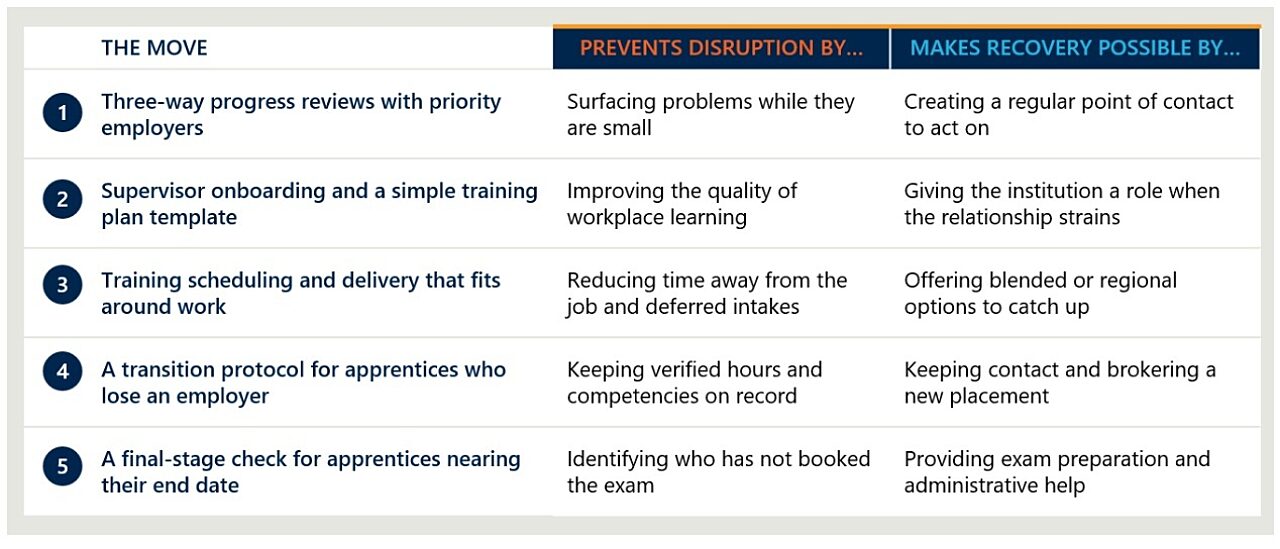
Taken together, these connections translate into five practical moves, each of which helps prevent disruption and makes it easier to recover from when it does occur. Institutions need not pursue all five at once. Progress reviews with priority employers and a final stage check build on relationships and information institutions already have, and are a sensible place to start.
A stronger role for institutions should mean a better return on Canada’s investment
The new investment will bring more apprentices into the system. The completion bonus will reward those who finish. The open question is who helps the large group in between: still registered, past their expected end date and losing momentum.
Colleges and polytechnics are well placed to fill this gap, provided they are equipped and willing to take a stronger leadership role. Equipped means data-sharing agreements with apprenticeship authorities, funding that recognizes support between training blocks, and clear roles agreed with employers and unions. Willing means a change in how institutions see their apprentices: as people they are helping to certify, not just students they teach for eight weeks at a time. This role will take time to build, and it will depend on partners as much as on institutions themselves. But the first steps sit within institutions’ own control.
The whole system benefits. Governments get a better return on billions of dollars of investment. Employers keep the apprentices they have already invested in. Apprenticeship authorities get earlier warning before an apprentice is lost. Apprentices get someone looking out for their progress across the whole journey.
For any institution, the starting point is three questions. Where do our apprentices lose momentum? Who notices when progress stalls, and who responds? Which partners would make disruption easier to recover from? The answers will determine how much of Canada’s new investment ends up as certified journeypersons.
Get in touch to discuss how your institution can help every apprentice keep moving forward and ensure Canada’s investment results in a strong pipeline.
Connect with Tyrone Collins and Ian Stone on LinkedIn.
Authors

Tyrone Collins
Director
Tyrone has over eight years’ experience in consulting and business analysis and has worked extensively in the higher education, vocational education and energy sectors.