
Share Insight


Idea In Brief
Stronger apprenticeship systems need stronger information
Achieving better completion rates requires data that reveals where bottlenecks emerge and which interventions have the greatest impact.
The situation is more complex than enrolment numbers suggest
Evidence shows the delays, attrition, and completion risks occur at different stages, highlighting the need to understand how apprentices move through the system.
Workplace factors matter as much as training provision
Many apprentices leave because of pay, job conditions, or employment disruption, suggesting that improving outcomes requires attention to employer capacity and apprentice experience.
Canada’s federal investment of more than $8 billion in apprenticeships reflects a clear policy ambition: grow the skilled trades workforce needed to support housing, infrastructure, energy transition and economic growth. Alongside the original Team Canada Strong investments, the federal government's new $2 billion commitment to provinces and territories is specifically intended to expand training capacity, increase access to apprenticeship pathways, reduce waitlists and improve completion rates.1 2
The announcement recognizes that apprenticeship success depends not only on attracting more apprentices, but also on the capacity of training systems to support them through to completion. Achieving the full return on this investment will require equally strong investment in the information needed to understand where barriers exist and which interventions are delivering results.
Apprenticeship systems are inherently complex. Bottlenecks can emerge at multiple points along the apprentice journey, from recruitment through to completion and progression into employment. Increasing demand without understanding these bottlenecks risks shifting pressure elsewhere in the system.
This is where labour market information has an important role to play.
Statistics Canada provides an impressive set of public resources that help policymakers and sector leaders understand apprenticeship activity and outcomes. These data provide valuable visibility into registrations, completions and labour market outcomes.
The next opportunity is to build even deeper insights into how apprentices move through the system and where interventions could have the greatest impact.
Rather than focusing only on how many apprentices enter training, policymakers may benefit from asking a broader set of questions:
- Which workers are most likely to transition from employment into apprenticeships?
- Where do delays occur between registration and the commencement of training?
- At what stages are apprentices most at risk of exiting?
- Which factors are most strongly associated with non-completion?
- How do outcomes vary across employers, providers, regions and demographic groups?
Answering these questions can help governments move from measuring activity to improving performance.
Considering the new investment, these are precisely the areas where stronger labour market information can help governments identify emerging constraints, target investment more effectively and monitor whether intended outcomes are being achieved.
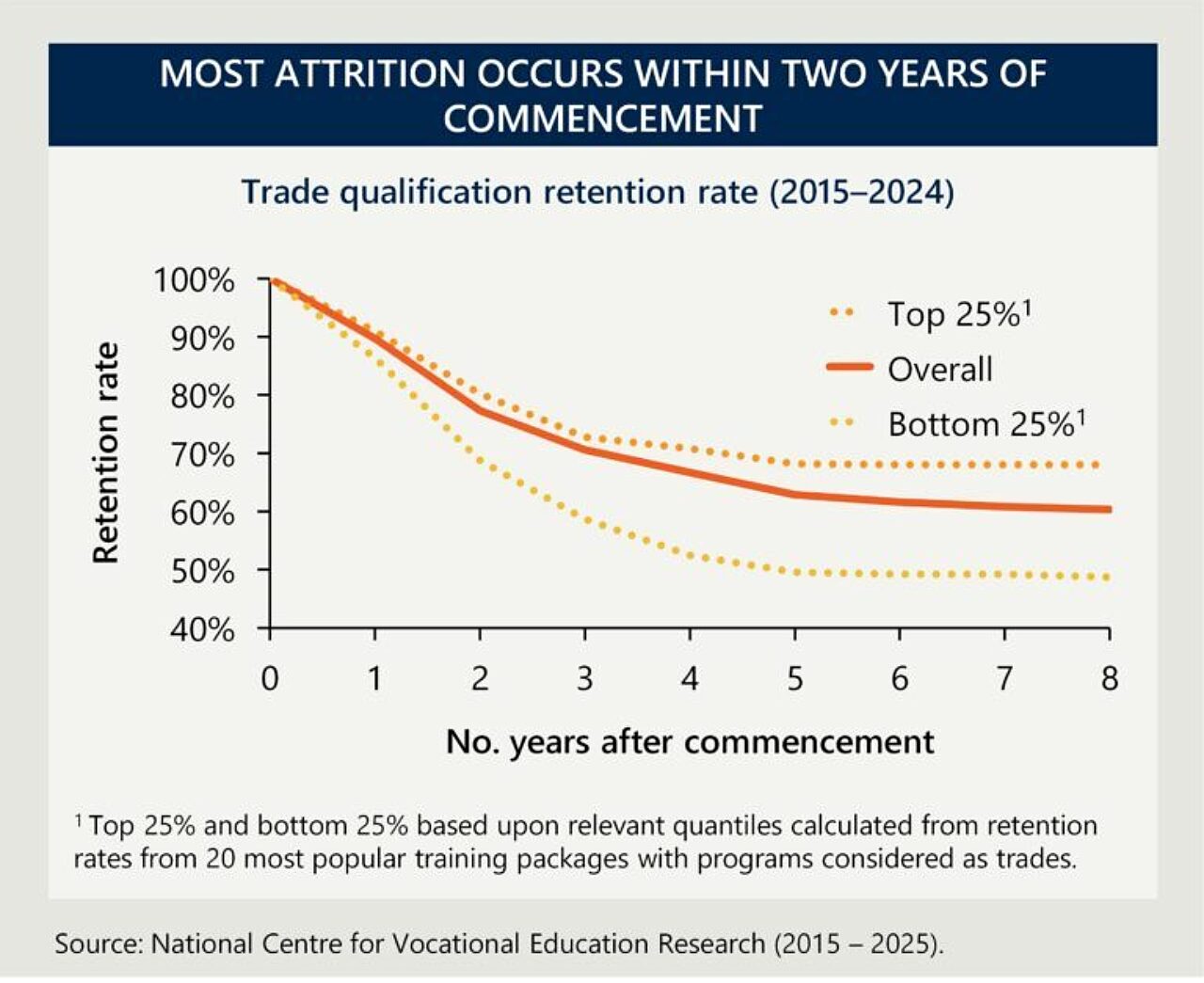
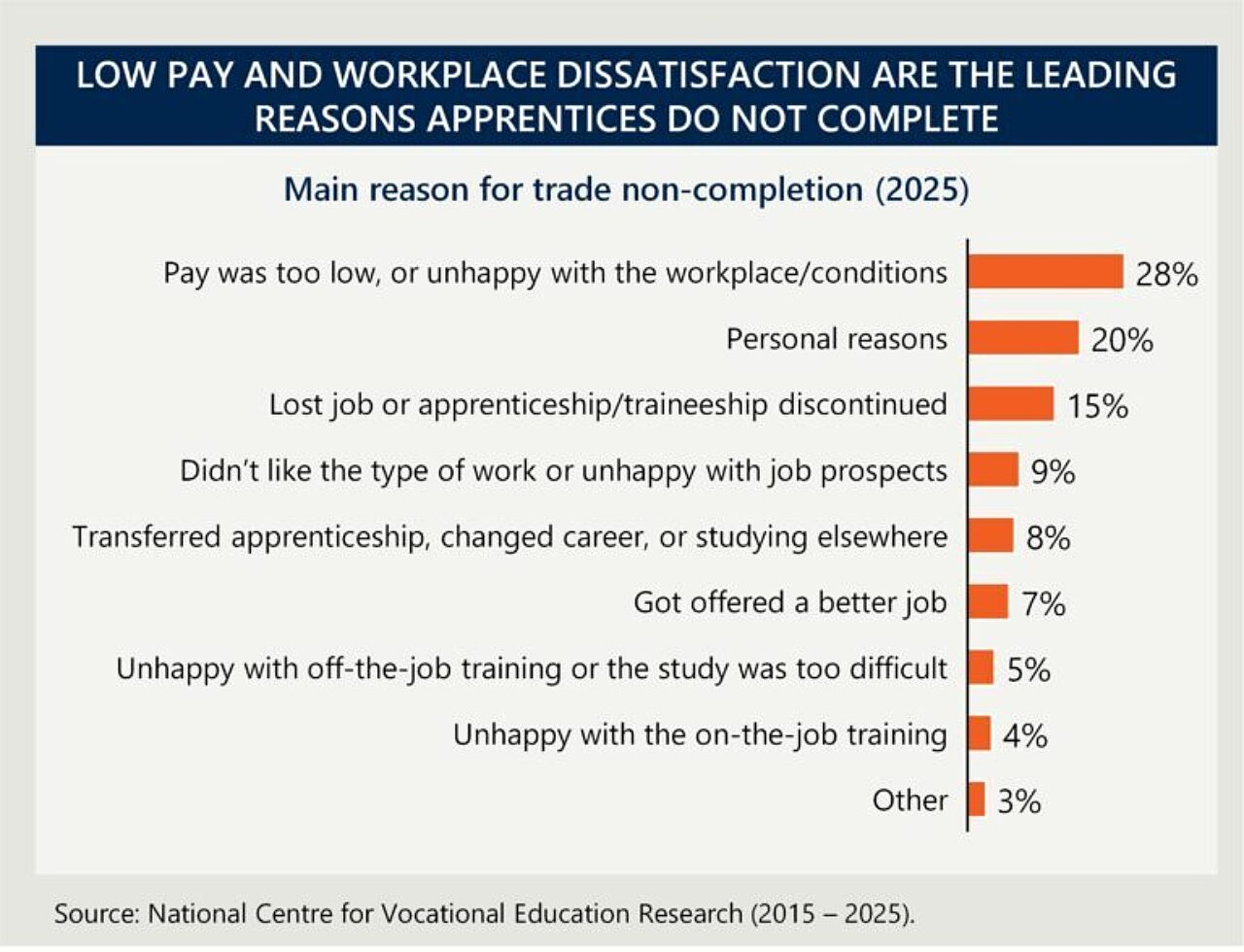
Australia offers a useful example of how labour market information can support apprenticeship success. Through the National Centre for Vocational Education Research (NCVER), detailed learner, provider and employer data provides visibility across the apprenticeship journey and can help identify where interventions may have the greatest impact. A limited selection of analyses is provided below.
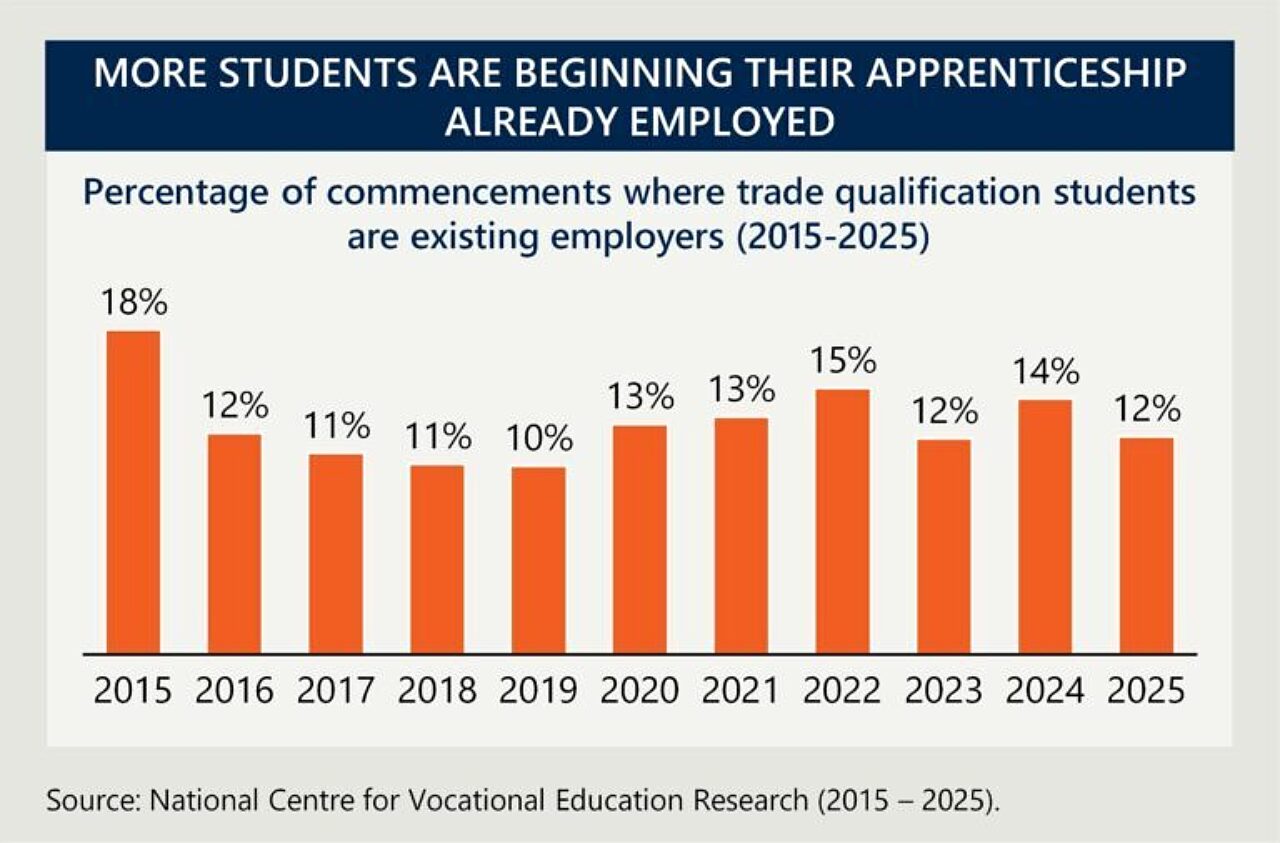
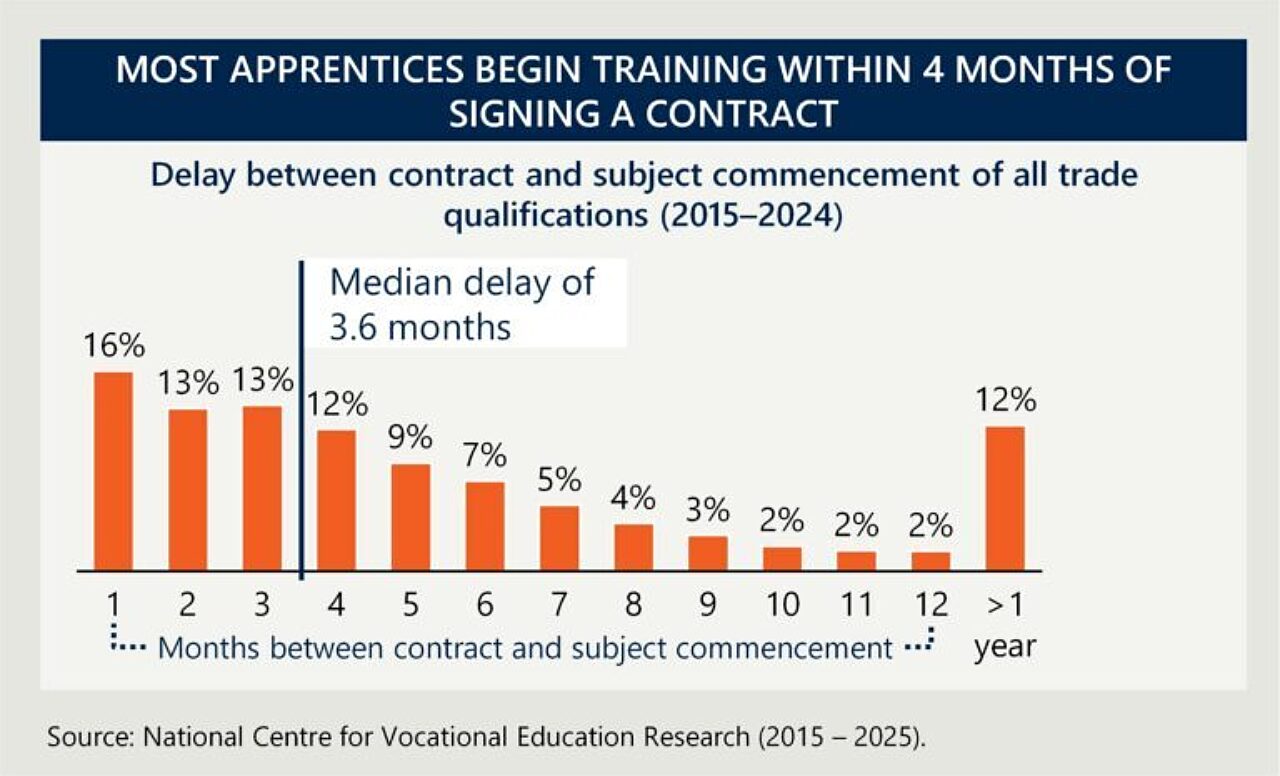
The insights highlight areas Canada may wish to pay attention to as announcements shift to implementation. Around 10–13% of trade apprentices are existing employees progressing into an apprenticeship, highlighting an important pathway from work into training. Once apprentices begin their formal training, delays can emerge early in the journey, with a median gap of 3.6 months between signing a training contract and starting training, and 12 per cent waiting more than a year.
The data also show that attrition is not evenly distributed. Retention falls from 100 per cent at commencement to around 77 per cent after two years and 66 per cent after six years, reaching 60 per cent by year eight, indicating that support needs can vary significantly across the apprenticeship lifecycle. We also see significant variations by apprenticeship. Importantly, the leading reasons for non-completion often relate to workplace experience rather than training itself. Low pay or dissatisfaction with workplace conditions account for 28 per cent of non-completions, followed by personal reasons (20 per cent) and job loss or discontinuation of the apprenticeship (15 per cent).
This type of analysis helps move the conversation beyond commencements to the factors that drive completion. It also provides an early warning system for emerging constraints in provider and employer capacity. As Canada invests in apprenticeship growth, stronger visibility across the full apprentice journey can help ensure funding translates into completions, skilled workers and long-term productivity gains.
The good news is that much of the foundation already exists. Canada has strong labour market institutions, increasingly sophisticated data capabilities and a growing commitment to evidence-informed policymaking. The next step may be less about creating entirely new datasets and more about connecting existing information, filling critical gaps and ensuring insights are accessible to decision makers across governments, industry and post-secondary education.
An $8 billion investment creates an opportunity to strengthen apprenticeship participation at scale. It also creates an opportunity to strengthen the information infrastructure that supports the system.
The two investments should be seen as complementary.
After all, the strongest returns on apprenticeship investment are rarely generated by funding alone. They are generated when funding is paired with a clear understanding of how apprentices move through the system, where capacity constraints are emerging and which interventions improve completion. That is ultimately the promise of labour market information, not simply describing the apprenticeship system, but helping it perform better.
Get in touch to discuss how better labour market information can improve apprenticeship completion rates and strengthen skills system performance.
Connect with Hamish Ride and Nathalie Mejia on LinkedIn.
A version of this article was published on the Labour Market Information Council (LMIC) website on 17 August 2026.
Authors

Hamish Ride
Principal
Hamish specialises in strategy and policy development, from direction-setting through to execution in education and other sectors.