
Share Insight


Idea In Brief
AI adoption is a leadership challenge first
Leaders need to create the conditions for people to use AI confidently, critically, and responsibly, rather than treating adoption as a purely technical implementation task.
People experience AI differently and legitimately
Sceptics, protectors, pragmatists, and innovators each see different risks and opportunities, so leaders need to integrate those perspectives rather than force premature alignment.
Middle managers need practical support
They carry much of the burden of translating AI ambition into everyday practice, so organisations must equip them with clear tools, quality checks, and learning rhythms.
Artificial intelligence is transforming how work is designed, decisions are made, services are delivered, and knowledge is created. When used responsibly, AI can increase organisational performance through augmenting human capability and automating routine work.
For leaders, the question is no longer whether AI will affect their organisation. It is whether they can create the conditions for people to use AI well. This means being confident, critical, and responsible with the use of AI in ways that strengthen rather than undermine the human foundations of work.
That makes AI a leadership challenge before it is a technology challenge. The dominant conversation has often focused on automation, productivity and risk. Those issues matter. But they are incomplete. AI also affects people’s sense of competence, autonomy, connection, and professional identity. It changes what good judgement looks like. It creates new tensions between speed and scrutiny, experimentation and control, innovation and accountability. And it places leaders, especially middle managers, at the centre of a transformation they are often expected to implement before they have fully made sense of it themselves.
People are reacting to AI in different ways
Many organisations initially approach AI as they would any other enterprise tool: choose a platform, write a policy, train users, manage change. That approach is necessary, but it is not sufficient. Generative AI is different because it enters the cognitive and relational parts of work. It can draft, summarise, analyse, translate, advise and simulate. It can appear fluent even when it is wrong. It can make people work faster while also making their thinking less visible. It can expand human agency or create dependence, anxiety, and confusion.
Because AI affects motivations, values and perceived losses, people do not respond to it in one predictable way. In many organisations, different groups are already emerging. Sceptics worry about quality, ethics, and unintended consequences. Protectors focus on safeguarding people, relationships, standards, and professional identity. Pragmatists look for practical use cases that save time or improve service. Innovators push quickly into experimentation and new possibilities.
None of these positions are inherently right or wrong. Each contains useful intelligence. Sceptics see risks enthusiasts may overlook. Protectors defend the human value that automation can obscure. Pragmatists translate ambition into usable practice. Innovators stretch the organisation’s imagination. The leadership task is not to force alignment, but to create enough psychological safety for diverse perspectives to be heard and integrated, while maintaining a clear focus on the organisation’s shared purpose, goals, and values.
The disruption is psychological as well as operational
To lead AI adoption well, leaders need to understand the human reactions it provokes. As part of self-determination theory, basic needs theory offers a useful lens because it highlights three psychological needs that shape motivation and engagement: competence, relatedness, and autonomy. AI can strengthen these needs, but it can also threaten them. As a result, many employees are consciously or unconsciously asking three questions: Do I still add value (competence)? Do I still belong (relatedness)? Am I still in control (autonomy)?
Competence is the need to feel capable and effective in what we do. AI can strengthen competence by helping people learn, solve problems, and perform tasks more effectively. But it can also challenge competence when people feel their expertise is becoming less valuable, or they are struggling to keep pace with rapidly evolving technologies.
Relatedness is the need to feel connected to others and part of something meaningful. AI can strengthen relatedness by making knowledge more accessible and enabling people to contribute more effectively to a shared goal. However, if AI replaces opportunities for collaboration, such as asking a colleague for advice, testing assumptions in a team discussion, or learning by observing others, it will impact us negatively. Organisations that rely too heavily on AI risk weakening the connections through which people build trust, develop judgement and experience belonging.
Autonomy is the need to feel in control of our actions. AI can strengthen autonomy by reducing administrative burden, supporting decision-making, and enabling people to focus on higher-value work. But it can also challenge autonomy when people perceive AI as directing decisions, limiting discretion, or shaping actions in ways that feel misaligned with their judgement, values, or intentions.
Effective AI leadership depends on six connected behaviours
Leading in an AI-enabled environment means working with tensions that cannot be solved once and for all. Leaders need momentum, because waiting for perfect certainty will leave organisations behind. But they also need scrutiny, because AI can generate confident mistakes at scale. They need to give people autonomy to experiment, but they also need oversight where decisions affect clients, communities, employees, or reputation. They need to encourage innovation but also define where caution is non-negotiable.
These tensions make human judgement and leadership more important, not less. AI can produce options, detect patterns and draft outputs. It cannot own context, values, or consequences. Leaders must therefore make explicit where AI assists and where people remain accountable.
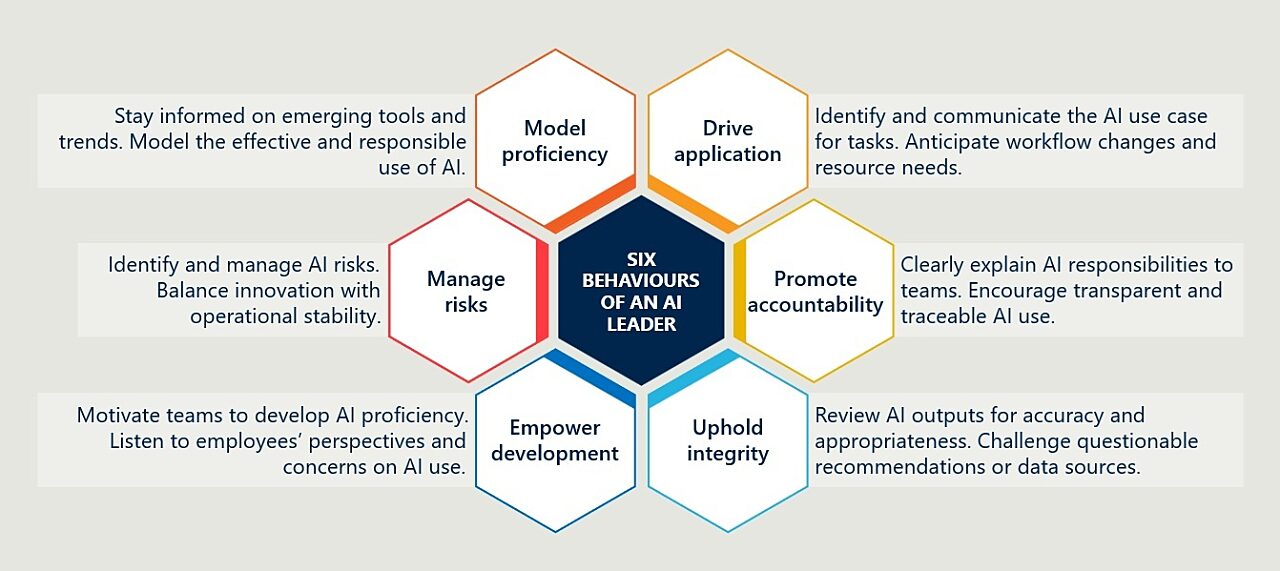
How can leaders and organisations use the six AI leadership behaviours?
- Assess leadership strengths and development needs across the six behaviours.
- Develop targeted learning, coaching, and support to strengthen the behaviours.
- Apply the behaviours through real-world AI use cases, experimentation, and reflection.
Importantly, the six behaviours do not operate in isolation. While leaders play a critical role in role modelling and driving adoption, sustained impact depends on organisational enablers such as psychological safety, capability building, governance, knowledge sharing, and risk management. Together, these create the conditions for AI adoption that is responsible, scalable, and sustainable. Middle managers are carrying the heaviest load
The burden of AI adoption often falls most heavily on middle managers. Senior executives may set bold aspirations: deploy agents, redesign workflows, reduce duplication, accelerate insight. Teams then look to their direct leaders for clarity: What are we allowed to use? What counts as good work? How much checking is enough? Will AI change my role? What happens if the output is wrong?
Middle managers must translate ambition into practice while managing up about what is realistic and managing down through uncertainty. They are expected to encourage experimentation, maintain quality, protect trust, allocate time for learning, and keep delivery moving. In many cases they are doing this while still developing their own AI confidence. Organisations that overlook this implementation burden risk turning AI adoption into another source of managerial overload. Organisations should equip middle managers with simple, repeatable tools for AI adoption. At a minimum, every manager should be supported to define team-level use cases, quality checks, escalation rules and learning rhythms. This is what turns AI from a source of overload into a manageable leadership practice.
Middle managers are carrying the heaviest load
The burden of AI adoption often falls most heavily on middle managers. Senior executives may set bold aspirations: deploy agents, redesign workflows, reduce duplication, accelerate insight. Teams then look to their direct leaders for clarity: What are we allowed to use? What counts as good work? How much checking is enough? Will AI change my role? What happens if the output is wrong?
Middle managers must translate ambition into practice while managing up about what is realistic and managing down through uncertainty. They are expected to encourage experimentation, maintain quality, protect trust, allocate time for learning, and keep delivery moving. In many cases they are doing this while still developing their own AI confidence. Organisations that overlook this implementation burden risk turning AI adoption into another source of managerial overload. Organisations should equip middle managers with simple, repeatable tools for AI adoption. At a minimum, every manager should be supported to define team-level use cases, quality checks, escalation rules and learning rhythms. This is what turns AI from a source of overload into a manageable leadership practice.
How can middle managers use this with their teams?
Middle managers can run a 30-minute “AI rules of the road” conversation with their team. Ask four questions:
- Where could AI safely save us time or improve quality?
- Where do we need human judgement, review, or escalation?
- What standards should we use to check AI-generated work?
- What do we need to learn together over the next month?
Then reinforce these agreements through a regular AI learning rhythm. For example, a 10-minute monthly discussion or dedicated communication channel, to share use cases, surface risks, capture lessons learned, and continuously refine team practices.
The leadership opportunity
The organisations that benefit most from AI will be those that make experimentation safe, make judgement visible, and make accountability clear. They will recognise that AI adoption is an ongoing shift in how people learn, decide, collaborate, and create value.
For leaders, this requires humility as much as confidence. They do not need to have every technical answer. They do need to ask better questions: Where is AI genuinely useful? What assumptions sit beneath this output? What skills might we be strengthening or weakening?
AI will continue to change the mechanics of work. But the deeper leadership challenge is human: helping people stay capable, connected, and in control as the tools around them become more powerful. In an AI-enabled environment, the leaders who succeed will be those who can hold ambition and responsibility together, accelerating adoption without outsourcing judgement, encouraging innovation without abandoning care, and using technology to expand rather than diminish human agency.
Get in touch to discuss how your organisation can build the leadership behaviors, team practices, and human-centered conditions needed to adopt AI responsibly and effectively.
Connect with Tessa Dehring, Philippa Prothero, and Annabelle Kerr on LinkedIn.
This article was developed with contributions from Sally Cutts and Liz O'Dell.
Authors

Tessa Dehring
Principal
Tessa currently leads Nous' Canada office and brings deep experience supporting organizations to enhance organizational performance, culture, and leadership.

Philippa Prothero
Principal
Philippa supports organisations to build future-focused workforce models, applying a strong data-driven approach and incorporating best practice at all points of the employee life cycle.