Share Insight


Idea In Brief
Human-machine teaming is transforming military command and control
Leaders must adapt to work alongside intelligent machines, making decisions at speeds beyond human reaction times.
The evolution of warfare requires a cultural and technological shift
Military leaders must become fluent in understanding data and AI-enabled outcomes to maintain strategic advantage.
Hybrid forces challenge traditional military logistics and readiness
The integration of uncrewed platforms imposes new burdens on maintenance, software assurance, and data management systems.
The cauldron of human conflict has always accelerated the adoption of advanced technology. The wars of the twentieth century saw the cycle of defensive weapons such as mines, machine guns, and barbed wire being overcome by manoeuvre using combined arms, tanks, aircraft, and artillery. The sophistication of weapons, sensors and guidance systems developed during the Cold War and the Space Age, and miniaturised using the silicon chip, has increased dramatically.
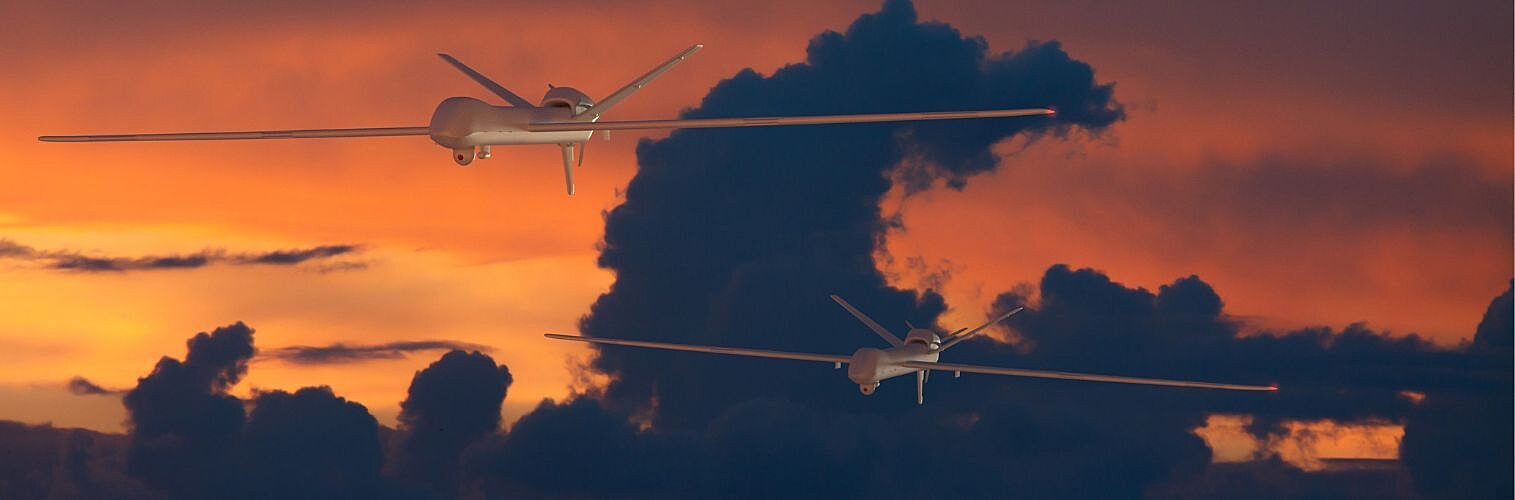
Weapons have evolved from being dumb to smart. This has enabled an enhanced degree of precision, using sensors and communications links to exercise control by human decision makers. More recently, we see human decision makers on the loop, i.e. overseeing machines working relatively autonomously within defined boundaries in time and space. These might include loitering munitions, for example, and latterly all manner of drones, which dramatically compress kill chains and decision action cycles.
An important question for military leaders across all environments is whether tried and tested command and control procedures are still fit for purpose in an age of AI and autonomy. How will leaders exercise control and work alongside intelligent machines, when decision making will be required at speeds beyond human reaction times? How do leaders manage battlespace which has humans and uncrewed platforms and autonomous machines in close proximity, while staying within legal and moral norms?
The inflection point: An era of robotic warfare has dawned
We are at an inflection point in the evolution of leadership and command on military operations. The professional education, training and exercising of military leaders at all levels will need to evolve to reflect both the opportunities and challenges as human-machine teaming, powered by agentic AI, becomes necessary and more commonplace in routine military operations.
The drivers for change include the escalating pace of technological innovation, the growing proliferation of autonomous systems across all plausible adversaries, the increasing vulnerability of traditional platforms, and the heightened political and legal scrutiny placed upon the use of force in democratic societies.
While the expensive, brutal, attritional nature of warfare has not changed (at the cost of blood and treasure), the technological means at the disposal of matched opponents and their proxies, combined with new tactics techniques and procedures, pose a huge challenge to apparently modern conventional forces. Moreover, the low cost of commercial off-the-shelf Unmanned Aerial Vehicle (UAV) drone technology is enabling terrorist organisations to explore new methods of asymmetric attack.
For British, Australian and Canadian forces – each deeply professional militaries with strong traditions of mission command – this inflection point will require a cultural as much as a technological shift. The essence of mission command and decentralised decision-making will remain, but these will exist in an environment where digital agents, predictive algorithms and autonomous systems shape the battlespace, sometimes before human commanders even frame their intent.
This might require a re-imagining of what “commander’s intent” means when elements of the force are non-human and capable of acting at machine speed. It also implies that future commanders must become as fluent in understanding data, software behaviours and AI-enabled outcomes as they are in reading maps or coordinating fire support. The challenge is to elevate leaders, ensuring that judgement, ethics, and strategic understanding continue to anchor an increasingly agentic battlespace.
Sophisticated military platforms are expensive, rare and vulnerable: Hybrid forces build resilience
Major military platforms have become hugely more expensive, while, simultaneously becoming more vulnerable. An aircraft carrier is vulnerable to drone attack; an exquisite defence investment, such as a fifth-generation fighter, or a rare C4ISR platform, can still be destroyed by an inexpensive drone while on the ground. The asymmetric costs for Governments and defence organisations with the most advanced technology presents a David and Goliath challenge. This emergent revolution clearly signposts the need for more affordable military mass, in the form of larger numbers of smaller platforms. Some of these platforms can be unmanned and selectively fully autonomous.
The shift from a few expensive, heavily protected platforms toward a more numerous, expendable fleet of autonomous systems echoes lessons drawn from both recent and historical conflicts. Militaries must confront the reality that adversaries can offset their technological disadvantages with sheer scale and low-cost innovation. In practice, this means rebalancing procurement philosophies away from decades-long acquisition cycles toward more agile, iterative development models that can field systems quickly and retire them without political controversy.
Not all drones are simple, disposable and cheap. Uncrewed Ground Vehicles will become more common, but they incur more costs due to their complexity. The costs and challenges increase further in the unforgiving maritime environment. Leaders will still need to continuously adapt and match their hybrid force packages to the threat and the prevailing meteorological conditions.
Congested battlespace
Battlespace control measures will need to evolve further to allow for the operation of uncrewed and autonomous vehicles on land, sea and in the air, alongside and among crewed platforms. Traditionally, tracked and wheeled vehicles would be separated on some routes. Even this simple solution becomes more of a problem if only some vehicles are crewed. The battlespace will be more congested with machines and conversely less densely covered with humans.
Soldiers obey rules of engagement, such as not firing across a boundary, for example. Such fundamental control measures are also necessary for armed robots. Humans are prone to errors resulting in blue-on-blue or blue-on-white engagements; machines need highly effective ways of identifying friendly forces (IFF) systems and processing sufficient situational awareness to complete their tasks.
As battlespace becomes increasingly saturated with signals, sensors and autonomous actors, deconfliction will demand far more than traditional separation by time, space or altitude. AI-enabled vehicles may manoeuvre in ways that humans cannot easily anticipate, and they may share data at speeds that compress decision cycles to moments. Forces will need doctrine that integrates automated deconfliction tools, dynamic IFF protocols and real-time cross-domain coordination, while the introduction of autonomous systems into environments with civilians or coalition partners places a heightened burden on commanders to ensure legal compliance and operational transparency. The mission threads in effects-based hybrid operations will become more complex and dynamic.
Human advantage is the key to success
The next generations of warships and aircraft will be designed to operate alongside uncrewed platforms, to increase the reach, lethality and survivability of mission essential, expensive assets. This increase in the number of platforms, dispersing weapons and sensors across a hybrid force, will change the shape and size on modern Navies, for example. Next generation manned aircraft will have Uncrewed Collaborative Platforms (sometimes described as a trusted wingman) flying alongside and more likely ahead of them in contested airspace.
The modern battlespace is already analogous to three-dimensional chess, with the environments delineated in time and in physical space. This layering of the battlespace will become more complex and dynamic to allow for autonomous platforms to operate, with sufficient buffer zones around them to mitigate risks of collisions, or blue-on-blue engagement.
Hybrid forces also challenge long-standing assumptions about logistics, sustainment and readiness. Uncrewed platforms may be cheaper individually, but their numbers impose new burdens on maintenance pipelines, software assurance teams, and data management systems. Militaries will need robust sovereign or allied supply chains capable of updating, repairing and certifying autonomous systems at a realistic operational tempo.
Hybrid capability (a mix of human and machines) is now appearing in hybrid operations as a feature of sub-threshold ‘grey zone’ conflict. Alongside disinformation, sabotage and subversion, from the Nordics to Poland, Belgium and Ireland, mysterious UAV overflights have been used to exert pressure on countries across Europe.
Hybrid thinking will become the new normal. Military leaders will need to get the best for hybrid forces in an age where everything is in some way hybrid, from sub-threshold grey zone attacks to a mix of cyber-physical and conventional kinetic engagements.
Leadership and command
Leaders of hybrid forces will find themselves with more dispersed command chains. They may be seeing and hearing reports from assets, some of which are human, some of which are AI generated from remote robotic platforms. This will present new ethical challenges (is human authentication of targets needed; are all platforms the same, when, inevitably, more risk will be taken with uncrewed systems). Command and control will be exercised across secure communications links and crypto devices will need to be protected, potentially with kill switches and self-destruct features, if a valuable platform is prone to capture, for example.
Command and control may involve new modes of operation for Autonomous Collaborative Platforms (ACP) e.g. transit mode, self-defence-only mode, weapons tight, weapons free with defined potentially geo-fenced boundaries or kill boxes. And decisions will need to be delegated and automated as threats appear inside human reaction times, inside Observe Orientate Decide Act loops.
The inevitable consequence of this new evolution of technology is that ACPs will engage ACPs – we have entered an age of agentic warfare – machines fight machines, not as modern day crewed tanks do, but as independent platforms with level 5 autonomy 1.
Drone on drone engagements will become normal in the land environment. In an age of the drone safaris, hunting targets of opportunity, across around 20-30 km behind the zero line, this transparent zone filled with partly or fully autonomous threats slows down conventional military manoeuvre. The counter-measures continue to evolve.
New technologies in military use are rarely immediately successful. However, it is axiomatic that novel combinations, new technology and well-proven procedures can change the game. We already see autonomous vehicles optimised for certain missions, such as surveillance and reconnaissance, fire control, counter manoeuvre, collaborating (i.e. working in a ‘combined arms’ swarm). Counter measures ranging from anti-drone nets protecting supply routes, to jammers and various weapons systems are only ever partly effective. With sufficient controls in place, the next potential evolution would be swarms attempting to defeat swarms. It seems likely we will also see autonomous collaborative platforms communicating to coordinate their effects within and across domains e.g. sub-surface, surface and UAVs operating in the maritime operational area.
There is no single, simple way of addressing the questions hybrid forces, asymmetric costs and combined arms autonomy generate. Arguably, this is the most pressing command and control challenge for military leaders. This is a people problem, the essence of maintaining a human advantage. This is not a geek-led technology trend. The future battlespace will never be this simple.
So now is the time to think through the implications for recruitment, selection and training of leaders and for the logistic and maintenance challenges of enlarged fleets of dispersed platforms, especially in the maritime context. Staff colleges and exercises will be needed to tease out the tactics, techniques and procedures.
Capability planners will worry about force structures. However, before they can do so, surely there is a need to think through all the ethical and legal implications of lawfare lag implicit in human machine teaming. Maintaining operational control and command accountability with sufficient ‘glass box’ decision making will become challenging. New terminology, tactics and potentially doctrine, will be needed in the acronym rich military lexicon.
This is a people problem. Human advantage lies at the fulcrum of trade-offs between mission and environmental complexity and levels of autonomy being used in any human-machine team.
Get in touch to discuss how we can help you to help stay match-fit in a new era of uncrewed or fully autonomous AI powered warships, submarines, and other types of vehicles and drones in the air and in space.
Connect with Mark Baines OBE on LinkedIn.