
Share Insight


Idea In Brief
For students finishing secondary school, purposeful pathways enhance completion
Systems must align academic, vocational and hybrid options so students graduate with confidence, direction and wellbeing, not confusion or disengagement after Year 12 completion.
Effective pathways blend learning, assessment, and careers guidance into classroom practice
Students stay engaged when teaching connects theory to real applications, credits transfer across options, and career education is embedded early and continuously for all.
Schools succeed when workforce capability and system coordination are treated as essentials
Clear roles, sustained development, partnerships and shared platforms enable leaders and teachers to deliver coherent pathways, while central support reduces burden and duplication systemwide.
Across Australia, education system leaders are rethinking what it means for students to complete secondary school. Finishing Year 12 leads to better long-term outcomes, such as higher rates of employment, more people pursuing further study, and increased general wellbeing. But completion alone is not enough. The goal now must be to ensure students finish school with direction, confidence, and a sense of purpose, not with one of exhaustion, confusion, or apathy.
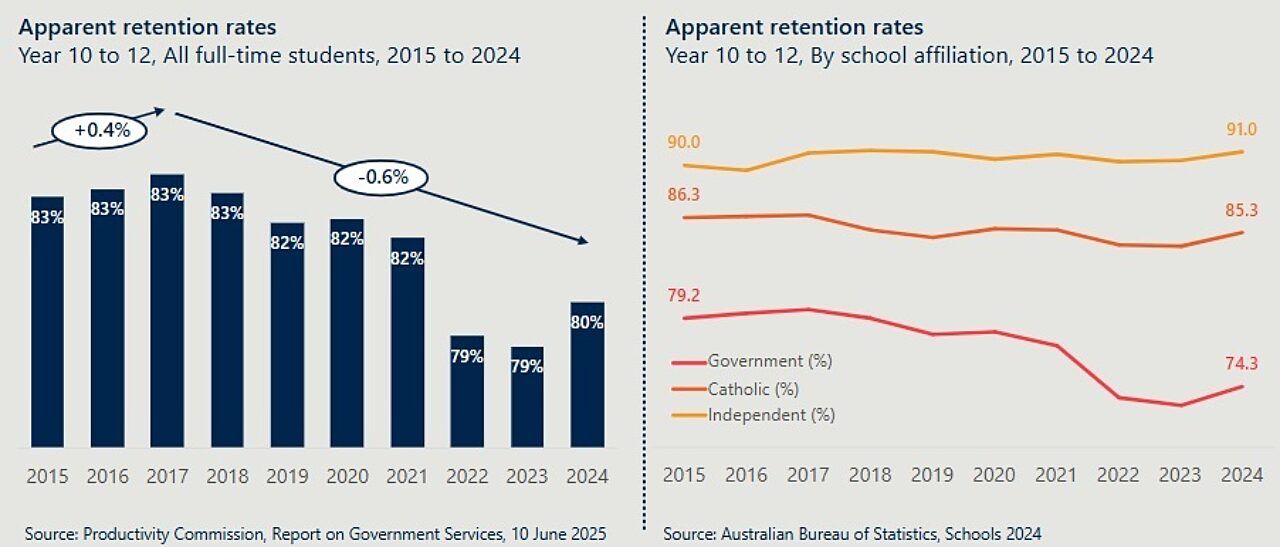
2024 showed an uptick in retention following the COVID years, and, while this is driven by myriad factors, academic, vocational, and hybrid options are now proliferating, giving students more ways to reach the end of their schooling journey aligned to their interests and capabilities.
Year 10 to 12 retention rates declined slightly across the country from 2017-2020 and dropped sharply across 2021-2023 due to the COVID-19 pandemic and aftershocks, with Government schools most affected, as shown below. Students from low SES and regional and remote areas and First Nations students were more likely to not complete Year 12.
However, new pathways all too often exist as a secondary rather than equal option and operate in isolation. This leaves students and schools struggling to realise their potential and connect the dots. To make them work – and to deliver real return on investment – systems need to think in coordinated, systemic ways.
Three elements are critical: aligned and engaging learning experiences, a capable and committed school workforce, and coordinated, responsive support from the centre. Together, these form the foundation for a system where every student can finish school not just with a certificate, but with confidence that they can thrive in learning, work and life after school.
Aligned and engaging learning experiences
The first challenge is to have a clearly described vision and set of student outcomes that the system is focused on. This underpins learning experiences that are diverse, engaging, and meaningfully aligned with students’ interests and aspirations. Multiple learning options should be provided, from traditional academic programs to vocational and applied learning, and, crucially, help for students to navigate between them.
School systems and individual schools have traditionally framed these pathways as mutually exclusive: “academic” or “vocational.” The most effective models blend both. A student might combine English and Maths with applied technology or hospitality, gaining both theoretical and practical skills. This dual approach builds confidence and keeps students engaged, while also broadening their mind to post-school opportunities.
Pedagogy matters. Whether a student is working toward university, a trade, or full employment, teaching must combine explicit instruction with opportunity for critical reflection and practice. Students learn best when they are first supported to fully understand how to approach a task and then given space to try to solve it themselves. This will often involve getting it wrong, and that’s okay if they are supported to identify what to do differently next time. Singapore’s applied learning initiatives demonstrate good practice in supporting students to connect academic knowledge with practical learning.
Singapore’s Applied Learning Modules (ApLM) and Programme (ALP) connect classroom learning with real-world applications
The Ministry of Education implemented two applied learning initiatives to integrate practical, hands-on learning into the student curriculum.
ApLM provides secondary school students with practical experience in real-world tasks. The modules span diverse fields such as entrepreneurship and online marketing and offer early exposure to industry-relevant skills. ALP enables students to apply classroom learning through mini projects and problem-solving tasks. These activities demonstrate the relevance of academic knowledge in practical settings.
The initiatives are recognised by students, parents and educators for enabling authentic and work-integrated learning that deepens real-world understanding and supports clearer career pathway decisions.
Embedded career education can make learning more relevant. Every subject, from history to physics, physical education to viticulture, should help students understand how their learning connects to future study or work pathways. The traditional model – where students study for twelve years and then, at the very end, meet a careers counsellor – no longer makes sense. Specialist staff still have a vital role to play, but their engagement with students must be more regular and is most powerful when it complements what happens in the classroom.
Finally, schools must partner with local businesses, community organisations, and tertiary institutions to create authentic, hands-on opportunities. Work experience placements are valuable but limited. Apprenticeships, vocational tasters, mentoring programs, and university open days can all give students tangible insights into potential futures. When students can test and experience different pathways, they are far more likely to find one that fits.
A capable and committed school workforce
None of this is possible without skilled and committed leadership. The best pathway strategies begin with a culture that values diverse definitions of success and recognises the importance of career education alongside academic achievement.
This cultural shift requires clear roles and responsibilities, for school leaders, teachers and career educators. Leadership teams need to drive the overall strategy. Subject teachers should understand how their content connects to real-world applications. Career educators must have qualifications, specific contributions to complement the work of subject teachers, and time to provide meaningful guidance and support. Partnership coordinators, where they exist, should build and maintain relationships with local employers, TAFEs, and universities. Third parties must have distinct and complementary roles, whether focused on industry engagement or student support.
Building these capabilities takes investment. Schools need professional development pathways that equip staff to guide students through an increasingly complex education and work landscape. Too often, career education and pathways support is an add-on, something handed to a teacher who happens to have space in their timetable. Without training, time, or strategic direction, even the most enthusiastic teachers struggle to deliver effective support and/or dedicated programs.
The UK government has adopted the Gatsby Benchmarks as part of its Career Strategy for secondary schools. These benchmarks define clear roles and expectations for staff to deliver a comprehensive careers program that provides clear pathways for students. They also emphasise the importance of ongoing staff development to ensure students receive consistent and high-quality support.
The updated Gatsby Benchmarks highlight careers as a whole-institution effort
The Gatsby Benchmarks provide a framework for careers guidance and are widely adopted by the UK schools, colleges and training providers. The 2024 update emphasised careers as a whole-institution and whole-staff endeavour, with defined roles for all stakeholders.
The Benchmarks require each institution to appoint a trained Careers Leader to develop and coordinate the careers programs, supported by qualified advisers who provide personalised guidance. School leaders set direction and embed career pathways in priorities, while teachers link curriculum learning to careers.
The Benchmarks also emphasise the need for ongoing staff development, including training and industry encounters. For example, more than 3,000 Careers Leaders have completed nationally developed training to strengthen career provision.
The Gatsby Benchmarks have transformed careers education and are expected to make a lasting impact over the next decade. Institutions meeting more benchmarks report fewer young people becoming NEET (Not in Education, Employment or Training).
Coordinated and responsive support from the centre
Even the best schools can’t do this work alone. Governments, school systems, and education authorities have a crucial role to play in ensuring schools are supported, not overwhelmed.
People at the system level need to combine policy expertise with practical understanding of how schools operate. Funding envelopes need to be targeted and sufficient. These central teams need to strike a delicate balance: schools should have enough autonomy to tailor programs to their context, but enough direction to ensure good practice is known and shared to make schools’ lives easier to drive for strong student outcomes.
Policy alignment is only part of the picture. Central offices can significantly ease the administrative burden on schools by coordinating processes, streamlining reporting requirements, and offering shared resources. Too often, schools are left to reinvent the wheel, managing data, partnerships, and administrative and compliance tasks independently when these could be handled at scale to avoid duplication and inefficiency. The provincial government of New Brunswick leveraged regional partnerships through Centres of Excellence to deliver skills training and support career development for students. These Centres strengthen the province’s talent pipeline and help address skills shortages.
Centres of Excellence in New Brunswick prepare students for better career pathways
The provincial government of New Brunswick partnered with employers to establish Centres of Excellence that help students explore and prepare for career pathways.
Each centre brings together stakeholders from education, government, employment and the community to provide oversight and engages major employers and industry bodies for broad representation.
Student opportunities focus on three areas to strengthen career support:
- Career guidance through tailored talks, workplace visits and mentoring.
- Work-related learning linking classroom content with real-world applications.
- Experiential learning via work placements and virtual opportunities.
Students in the final two years of upper secondary education can enrol in vocational-focused courses alongside traditional academic studies. These cooperative education programs allow students to begin training and certification early, creating clear pathways to employment.
Technology can help. Many school systems have enterprise-wide policies and processes, but fragmented technological infrastructure. Each school might use its own learning management system, data platform, or tracking tool, making collaboration and consistency impossible. Moving toward enterprise-wide systems – with shared platforms for managing pathways, career information, and partnerships – would save time and money while improving visibility and outcomes.
The goal is a coherent system where people, processes, and technology work together. Schools should feel supported, not monitored; guided, not constrained. Central offices should provide the scaffolding that allows schools to focus on what matters most: teaching, learning, wellbeing and helping students plan their futures.
The path ahead
If systems can align these three elements – engaging learning experiences, a committed workforce, and coordinated system support – they will improve and transform what Year 12 completion means.
The challenge lies in coordination. A system where every level, from the classroom to the ministry, is aimed in the same direction is hard to realise, but worth it: learning feels purposeful, staff feel empowered, and schools become engines of aspiration that contribute to enduring community prosperity.
Get in touch to discuss how you can ensure your students finish secondary school with purpose.
Contact Alex Snow on LinkedIn.
This article was prepared with input from Hamish Ride and Stella Zhang.