
Share Insight


Idea In Brief
Rural workforce shortages are solvable
The evidence already shows what helps: local training, better attraction, stronger retention, redesigned care models, and systemic planning.
The real gap is coordination
Rural health organisations often hold only part of the answer, so progress depends on aligning the different levers across a region.
Action can start immediately
Leaders don't need to wait for another strategy if they can identify the binding constraint and mobilise the right partners.
People living in regional, rural and remote Australia experience poorer health outcomes than people in major cities. They also receive less healthcare investment. Regional, rural and remote communities carry 1.4 times the disease burden of major cities yet receive around $8.35 billion less in health expenditure each year than they would if access matched that of major cities. This equates to around $1,090 per person.
Health workforce shortages contribute to these outcomes. People in regional, remote and very remote areas had access to between five and six fewer health workers per 1,000 population than people living in metropolitan areas. This was the lowest rate of any remoteness category. Specialist shortages are particularly acute. In 2021, major cities had 188 full-time equivalent medical specialists per 100,000 people, compared with 25 in very remote areas.
There is emerging evidence about activities that can help grow the rural workforce
Rural health organisations experiencing workforce challenges do not need to wait for a government strategy or funding to take action to address shortages. There is already evidence about individual initiatives that can help grow and sustain the rural health workforce. These span five areas of action.
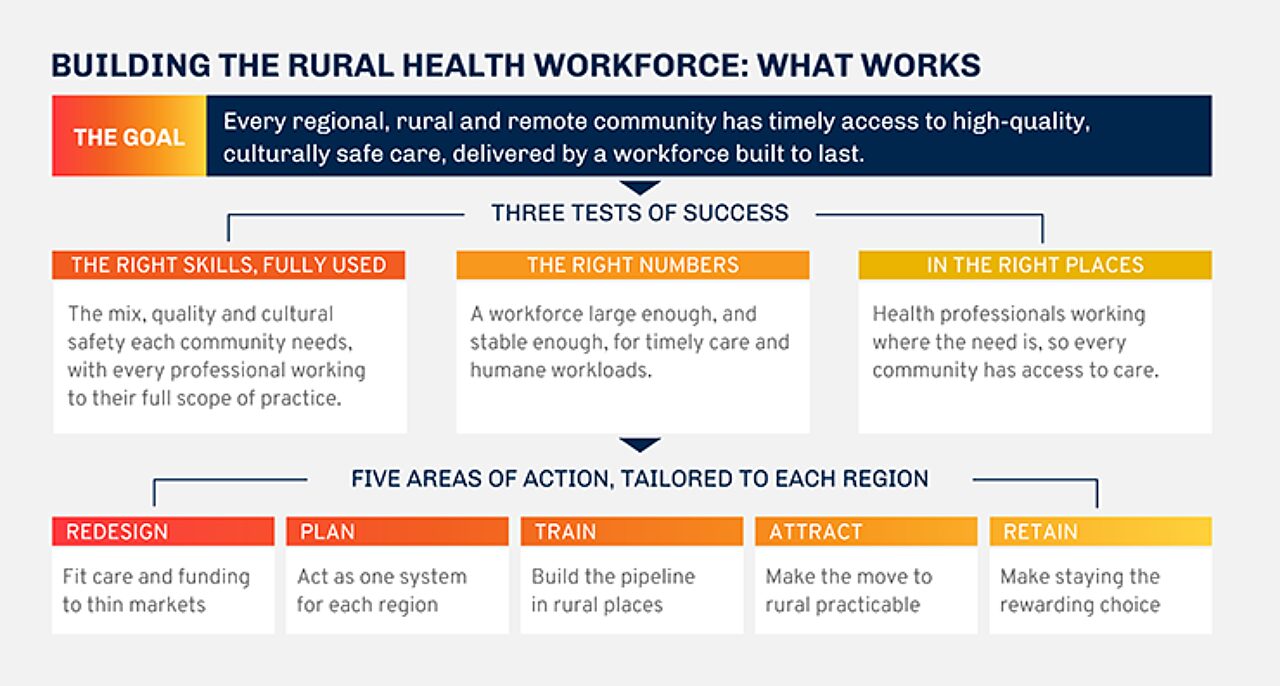
- Train the workforce locally. People who grow up in rural areas, who train in rural health services, are more likely to practise rurally, especially in medicine. Programs such as Rural Health Multidisciplinary Training and Queensland’s Rural Generalist Pathway have strengthened rural training pipelines, supported rural careers and helped restore services in smaller communities.
- Attract new workers for the region. A combination of financial incentives, practical supports such as identifying housing, employment for a health workers partner, and schooling for children can help attract and retain workers from other areas.
- Retain existing workers. The most effective ways to retain existing staff includes adequate supervision, manageable workloads, career progression opportunities, professional connection, and integrating with the rural community. Models that reduce friction in rural career pathways, such as the Single Employer Model for general practice training, can remove practical reasons for people to leave.
- Redesign workforce and service models. Thinking innovatively about workforce and service models including workers operating at the top of their scope of practice, team-based care, outreach services and virtual care can provide people living in rural areas access to services that could not otherwise be sustained. Aboriginal community-controlled health organisations have long demonstrated salaried, team-based and community-accountable models, and scope-of-practice reform can help the system deliver more care from the workforce it has.
- Plan systemically. Making the best use of scarce resources, limited funding and a small number of rural health workers means joint workforce planning across providers, peak bodies, commissioning bodies and governments. Workforce initiatives work best as coordinated packages. International and Australian reviews show they need to be tailored to local circumstances and targeted to where need is greatest.
Growing the rural health workforce requires collective action across five connected areas
Workforce challenges in rural communities are shaped by a diverse network of organisations, each holding different policy levers. Universities, specialist colleges, health services, general practices, Aboriginal community-controlled health organisations, Primary Health Networks, governments and local councils all influence how the workforce is trained, attracted, retained and supported.
It is not feasible for rural health services to directly provide the same level and breadth of specialist care that is available in metropolitan areas. This emphasises the need for joint planning and collaborative workforce models.
Our framework brings together the evidence on what works and the organisations best placed to act. It focuses on three outcomes: a workforce with the right skills, enough workers to meet community needs, and a better match between workforce supply and where care is needed. Five connected areas of action support these outcomes.
Growing the Aboriginal and Torres Strait Islander health workforce is fundamental to this agenda. It cuts across all five areas of action and requires genuine partnership with Aboriginal community-controlled health organisations as employers, educators, service providers and workforce leaders.
Case study: Growing the rural workforce collaboratively
Challenge
A partnership of health services, universities and research organisations engaged Nous to address longstanding workforce shortages across a large regional and remote area of Australia.
Regional cities struggled to staff specialist services. Rural towns faced shortages across almost every profession. Remote communities relied heavily on temporary staff. Decades of effort had not delivered sustained improvement.
Approach
Nous mobilised the organisations and the evidence to identify pragmatic solutions through a three-stage process:
- Review the existing initiatives. We analysed regional workforce data and mapped more than 40 workforce initiatives delivered by governments and local organisations. We assessed each initiative against the evidence base, identifying its evaluation status, target workforce issues and gaps in coverage.
- Identify the key barriers. Through consultation with more than 30 leaders from public, private, primary care and Aboriginal community-controlled health sectors, we explored the underlying causes of workforce shortages and the factors that had limited the success of previous efforts.
- Build regional ownership. We facilitated workshops across every health service area in the region, followed by a region-wide prioritisation workshop. Participants assessed the potential solutions against four questions: what is the underlying problem, what new approach could be taken, who needs to act, and who needs to enable it.
Outcomes
The work gave the region its first integrated picture of workforce activity, drawing together more than 40 initiatives and detailed workforce data.
The review found that most of the initiatives had not been formally evaluated. Many focused on recruitment incentives, while retention received comparatively little attention.
The analysis also highlighted collaboration as a critical missing lever. Performance targets, funding arrangements and organisational boundaries had unintentionally created competition for the same workforce.
In response, regional leaders developed a shared workforce agenda tailored to local needs. Priority initiatives included:
- school-to-health career pathways
- shared employment models and portable entitlements
- streamlined credential recognition
- generalist-led care supported by regional specialist networks.
Several areas have since established chief executive forums to oversee implementation and maintain momentum, creating a platform for sustained regional collaboration and workforce reform.
Every organisation can act now
Health departments, workforce agencies, networks and service providers can begin by asking five questions:
- Which of the five areas is your binding constraint? The answer differs by profession and by place, and it determines which measures are most likely to deliver results.
- What initiatives are already running? Most regions operate a dozen or more workforce initiatives without a single view of how they fit together. Mapping them often reveals overlaps, gaps and initiatives about to lapse with no owner.
- What are you measuring? Counting placements delivered and roles advertised rewards activity. Counting practitioners who remain in the region at three and five years rewards retention and long-term impact.
- Which levers don't you hold? Who does? Training, employment, funding and regulation sit with different organisations. Naming them is the first step to aligning them.
- What is the smallest group that could act together? Progress rarely needs the whole region at the table. It needs the two or three organisations whose levers touch the binding constraint.
The building blocks of a stronger rural health workforce are well understood. The challenge is not to invent more initiatives but to choose the right mix for each place and align the organisations that can make them work.
Get in touch to discuss how your organisation can help build a stronger rural health workforce through practical, place-based collaboration.
Connect with Jenny Cleary, Ian Thompson, Ben Whitton, and Luke Anderson on LinkedIn.
Authors

Jenny Cleary
Principal
Jenny has almost 20 years of consulting experience working across the Australian and Irish health systems.

Ian Thompson
Principal
Ian has 30 years’ experience in Australian health care, working at Federal and State Government levels, in operational management and as a consultant.

Ben Whitton
Director
Ben is a public policy expert with extensive experience in a range of sectors including health, mental health, disability, child protection and housing.