
Share Insight


Idea In Brief
Major platforms still matter, but their role is changing
Instead of trying to deliver every capability themselves, they should provide a stable core that supports faster, more adaptive services built around them.
Stabilise, build the foundation, then orchestrate
It's crucial to secure the current system, strengthen the integration layer, and create differentiated value through AI-enabled workflows, agents and experiences on top.
This approach is not a deferral, but a different investment model
It replaces slow, monolithic replacement cycles with continuous delivery that produces value sooner while preserving flexibility as technology and user needs evolve.
Major platform investments have long been a cornerstone of how complex organisations manage technology. ERP systems, case management platforms, revenue systems, clinical information systems, student management platforms. These are essential infrastructure. Replacing them has always been difficult and high stakes. But the decision logic, at least, was well understood: a system reaches end of life, you build a business case, secure funding, run a programme, and operate the result for the next decade or more.
That logic is under strain. Several organisations we are working with across government and higher education are facing major platform decisions right now, and finding it genuinely difficult to commit. The core tension is temporal: what does an enterprise platform need to be in five years? The capability landscape is shifting faster than any business case can credibly capture, and the investment horizon for these platforms is typically 10 to 15 years. Writing a confident long-term business case in this environment is a different proposition than it was even three years ago.
This is creating two responses, neither of which is comfortable. Some organisations are experiencing a kind of strategic paralysis: they know they need to act but cannot see clearly enough to commit. Others are pressing ahead with major investments, but doing so with an awareness that the risks are different and potentially larger than in previous cycles: the risk that you spend five years and significant resources delivering a platform that is already behind the world in which it is being implemented. Both positions are difficult. Both are rational. And both suggest the underlying decision framework needs to evolve.
The platform’s changing purpose
Major systems have always sat alongside other tools and capabilities. No organisation has ever relied on a single platform for everything. But the balance has been heavily weighted toward the core: the ERP or the student management system or the clinical system was expected to carry most of the business logic, most of the workflow, and most of the user experience. Supplementary tools existed, but they were secondary: filling gaps rather than carrying strategic weight.
That balance is shifting. The move toward composable, modular architectures has been underway for years, but it struggled to gain full traction, often running up against the same procurement and investment infrastructure designed for monolithic programmes. AI has changed the equation. It is lowering the cost of what can be built on top of a stable platform, accelerating the speed at which it can be delivered, and expanding the range of what the orchestration layer can do. Critically, the orchestration layer is no longer just about screens and user interfaces. It increasingly includes agents that act autonomously, automated workflows that require no human interaction, and interaction modes that may not involve a screen at all. The capabilities that sit on top of the platform are becoming more varied, more intelligent, and less tied to traditional application patterns.
The GovERP experience provides a useful reference point, not as a critique, but as an illustration of how thinking has evolved even in a short time. The program invested $344 million over five years to build a consolidated ERP across some 90 agencies. The Independent GovERP Reuse Assessment recommended smaller-scale projects over shorter timeframes and a core-and-edge architecture: a clean common core with capability built at the edge. That was sound advice in mid-2024. In mid-2026, the edge can move at dramatically different speeds and costs than even the panel likely envisaged. Organisations are shifting from a world where customisation was expensive – and where many over-bespoke systems, creating legacy debt of their own – to one where the edge can be personalised affordably, iteratively, and in ways that don’t compromise the core.
A different strategic pattern
If the platform’s purpose is shifting from “complete solution” to “stable foundation,” the investment pattern must shift with it.
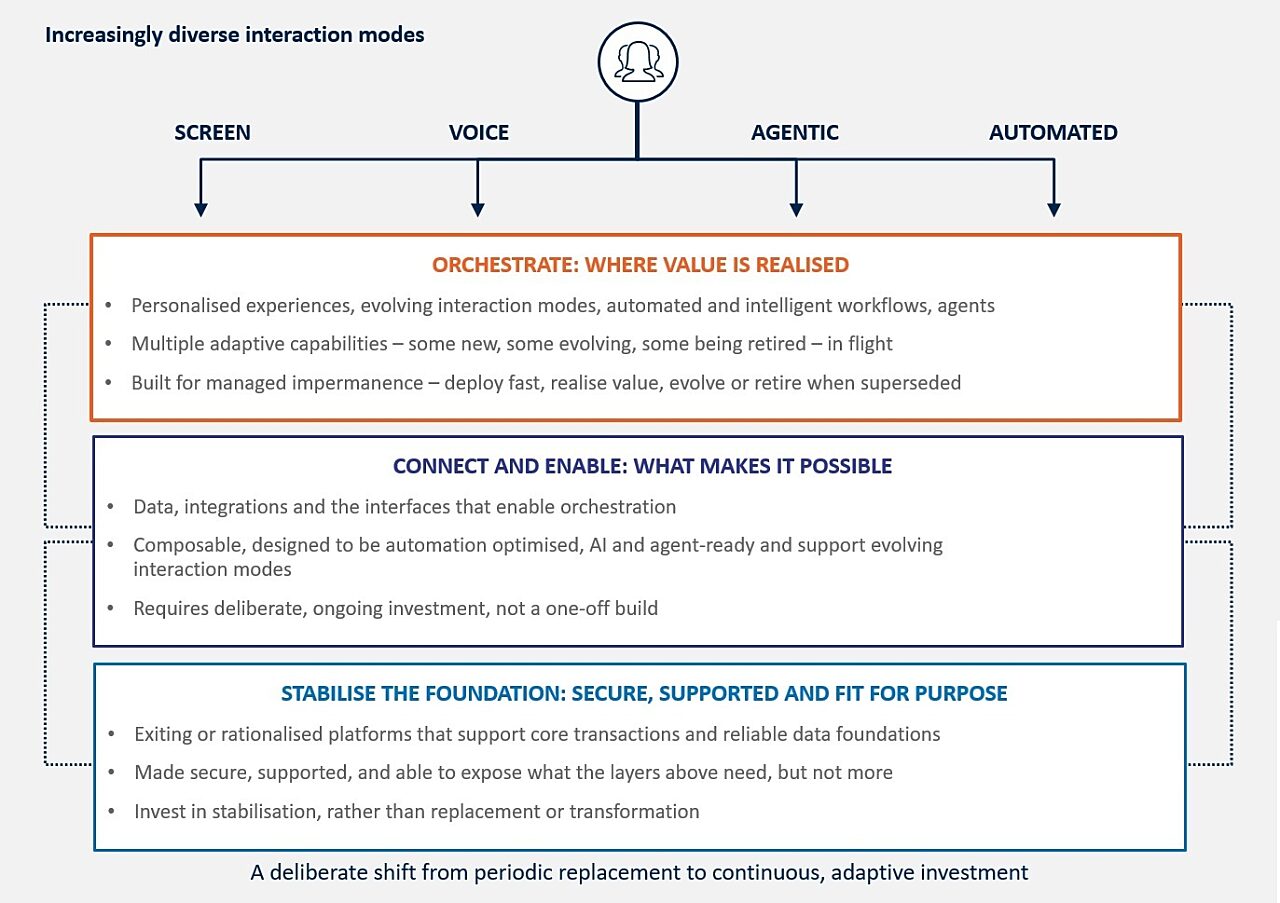
Stabilise the current platform. Ensure it is secure, supported and able to expose data through modern interfaces. If the system works reliably as a data and transaction layer, that may be enough, and the investment required to make it work well in that role is a fraction of a full replacement.
Treat it as a foundation, but a foundation designed for the new orchestration layer, not just for traditional application interfaces. This means investment in the integration layer and interfaces, but also in making the platform agent-ready and automation-optimised: able to be called by autonomous agents, to feed automated workflows, and to support interaction modes that may not involve a human user at all. The foundation layer is evolving from ‘enables our applications’ to ‘enables everything that acts on our data and processes.’
Orchestrate the value on top. Build the differentiated capability in an adaptive layer that can move faster, cost less and be changed as needs evolve. Some investments will be very small: a team building an AI workflow in weeks. Others will be mid-scale integration projects. A few will still be substantial. The point is that the pattern of investment changes from periodic and monolithic to continuous and adaptive. The orchestration layer itself is broader than it used to be, not just the user interface, but agents, automations, and new interaction modes that were not possible or practical even recently.
This is not deferral. It requires deliberate, ongoing investment, deployed differently. And it requires a different capability model: not large project teams that spin up for a multi-year programme and then wind down, but ongoing, capable teams and partners who can continuously deliver, evaluate and retire capabilities on the orchestration layer. In recent Nous work with a government department, one team with one AI agent identified more than 1,000 hours of recoverable effort per year, built quickly, at modest cost. That kind of investment is native to the orchestration layer and needs proportionate governance, not the same process as a major platform programme.
The contrast with the traditional model is worth drawing out. Under the replacement cycle, an organisation might invest little for a decade, then commit to a multi-year programme, then wait years to realise the full benefit. Under stabilise-and-orchestrate, investment is continuous but smaller: securing the foundation, delivering capabilities in weeks or months, evaluating them against outcomes, and replacing or retiring them as better options emerge. The aggregate value is higher, arrives sooner, and the organisation retains strategic flexibility throughout.
Building for a faster clock speed
The orchestration layer demands a different relationship with time. Not every capability built on top of the platform is meant to last for years. Some will deliver value for months and then be superseded as better approaches emerge. This managed impermanence – the deliberate building, using and retiring of capabilities – is becoming a core operational discipline, not an exception.
The evidence is building. Retool's 2026 survey of more than 800 enterprise builders found that 35 per cent of teams have already replaced at least one SaaS tool with a custom internal build, and 78 per cent plan to build more custom tooling in the year ahead. The build-versus-buy equation is shifting in real time as AI-assisted development compresses timelines and lowers costs. The market is moving the same way: vertical, purpose-built tools now account for an estimated 35 per cent of the SaaS market and are growing at close to double the rate of general-purpose horizontal platforms, because they align directly with operational needs and can be deployed faster. The era of the permanent, general-purpose application layer is giving way to something more dynamic: a portfolio of capabilities that evolves continuously.
Organisations that build the muscle to deploy, evaluate and retire rapidly on the orchestration layer will outperform those that treat every capability as a permanent asset. The organisation that stabilises its core platform and delivers multiple generations of AI-enabled capability on top of it will serve its users better than the one that spent the same period commissioning a replacement.
The question for every major platform decision
Every organisation facing a major platform business case should now ask: what value can we derive on top of what we have before we commit to replacing it? What is the minimum viable foundation, and what can be delivered adaptively on top?
A government agency with an ageing case management system could invest in stabilising the platform and opening up its data layer, then build AI-enabled triage, automated workflow routing and agent-assisted case management on top, realising operational value in months while retaining the option to make a larger platform decision when the landscape is clearer. A health system approaching end of life on its clinical information system could secure the core, invest in the integration layer, and build the clinician-facing experience – decision support, automated scheduling, predictive alerts – in a faster, more adaptive way. A university could stabilise its student management system and build the student-facing experience on top: personalised, AI-driven, responsive, and replaceable as needs evolve – rather than committing to a five-year replacement when the target state is unknowable.
Many organisations are already moving in this direction. Teams are experimenting with AI, finding practical ways to build capability on existing platforms, and delivering value faster than traditional approaches allowed. The challenge comes as this scales, moving from isolated experiments to embedding AI-enabled capabilities into core operations. That is the point at which stabilise-and-orchestrate becomes a deliberate strategy, and where the investment model, the capability model, and the governance to manage a portfolio of evolving capabilities all need to be in place.
The cost of waiting isn’t stasis, but falling behind. Every month spent deliberating over a traditional replacement business case is a month where value could have been delivered on top of the existing platform. The business case itself is a moving target: by the time it is approved, the assumptions may already be outdated. The organisations that shift their investment pattern will build the institutional capacity to respond to a world that rewards adaptiveness over permanence.
Get in touch to discuss how to unlock faster value from your existing platforms without waiting for full replacement.
Connect with Michael Rathjen and Will Prothero on LinkedIn.
This is the second article in our two-part series on AI assurance. Read the first part here.
Authors

Michael Rathjen
Principal
Michael is an experienced advisor across digital strategy, policy and technology-enabled transformation. He is passionate about the role of technology in improving outcomes for people, government and organisations.