
Share Insight


Idea In Brief
Artificial intelligence is already in the classroom
Students and teachers are using it at scale, which means schools now need deliberate strategies for safe, purposeful and educationally sound adoption.
The opportunity comes with real risk
AI can personalise learning, reduce workload and improve student support, but over-reliance could weaken critical thinking, judgement and professional expertise.
Schools need a clear adoption model
Whether they choose targeted pilots or system-wide platforms, success depends on strong strategy, governance, change management and human-centred implementation.
Artificial intelligence is rapidly transforming every sector, and school education is no exception. For secondary schools, the question is no longer whether to embrace AI, but how and how soon. Many students use generative AI to summarise texts and produce draft assignment work. Elevate Education’s 2025 survey of over 3,000 Australian high school students showed that 75 per cent are using AI regularly and up to 40 per cent are using it to write essays or solve maths or science problems. Student Edge’s 2025 survey found similar results, indicating that students are also using AI for learning and personal development outside of academic work.
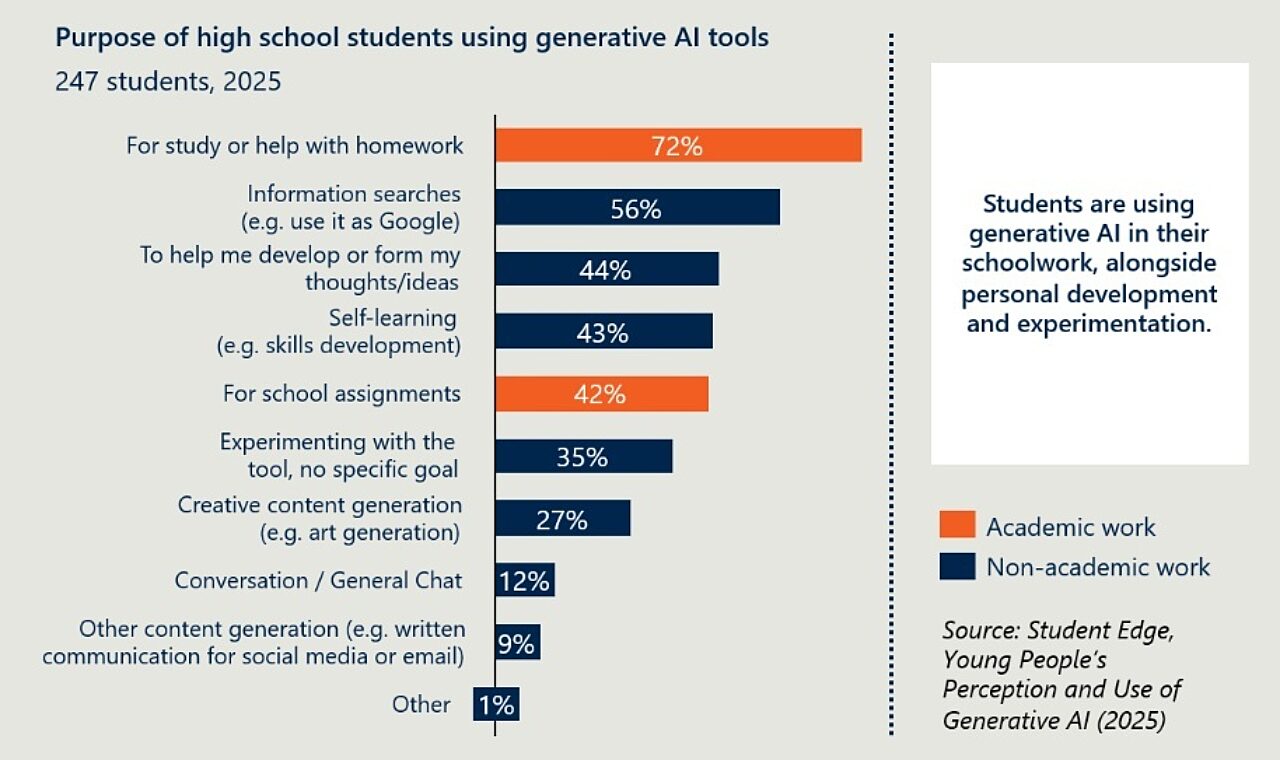
These examples, while appealing in many ways, highlight the risk of an erosion of foundational human capabilities to think critically and craft an argument either in written or verbal form. These skills come from searching for, filtering, reading and processing information carefully. It follows that students are less well-equipped to exercise judgement, solve problems, formulate opinions, and express them cogently and confidently.
A recent MIT study confirmed that this risk is real: it found that participants who used AI tools to write essays showed lower brain engagement, weaker memory of their work and underperformed against neural, linguistic and behavioural indicators. The researchers warned that while AI can make writing easier, heavy reliance on it may weaken thinking capacity and learning over time. UTS researchers have similarly argued that AI tools must promote deeper thinking and the development of foundational knowledge, rather than simply be used to generate answers.
What does this mean for teachers? According to the OECD’s latest Teaching and Learning International Survey, 41 per cent of teachers surveyed are already using AI in teaching-related work, with Australia ranked 4th in the OECD for teachers’ adoption of AI. Most common uses were for administrative tasks, summarising and learning content, and brainstorming lesson plans. The least common uses were for student assessment and student data analysis.
Many teachers in the survey reported time savings related to AI, yet (as with students) there is a risk of over-reliance. Teachers’ effectiveness hinges on their professional judgement and knowledge. Arguably, this can also weaken with overuse of AI, opening the prospect of pedagogy and assessment being AI-determined rather than appropriately tailored and informed by individual and classroom needs. It may assist with some aspects of explicit teaching, for example, but is there a cost to differentiated teaching?
Such questions are being addressed by schools and school systems in different ways, as illustrated in the case studies below.
Three use cases for AI adoption
From our work with schools and school systems across the country, we have observed that AI can contribute to improved school performance in three areas: teaching and learning; student experience; and school staff workload.
Targeted approaches
In some cases, systems are adopting a targeted approach, by which we mean they are focused on one of these three use cases – often starting with a pilot. National and international examples of these targeted approaches are set out in the use cases and examples below.
Teaching and learning
AI-powered tools can deliver personalised learning by tailoring content, pace and support to each student’s strengths and needs. Intelligent tutoring systems, adaptive assessments and real-time analytics can give teachers powerful insights to identify gaps early and target specific support for students. Teachers remain the architects of meaningful learning, sparking curiosity, guiding critical thinking and providing the emotional connection and professional judgment that technology cannot replicate. These innovations can enable teachers to be facilitators of deeper learning rather than transmitters of information.
Example: Brisbane Catholic Education (BCE) embedded AI tools for personalised learning
BCE has embedded AI across its school system to support more personalised learning, tailored to individual needs and levels of understanding. Eligible students (aged 13+) use the Microsoft Copilot tool to explore ideas, receive real-time assignment feedback, and develop digital literacy skills in a safe, monitored environment. Educators use the AI within Microsoft 365, automating administrative tasks so teachers can focus on one-on-one student interaction,
Importantly, BCE abides by the principles articulated in the Rome Call for AI Ethics: transparency, inclusion, accountability, impartiality, reliability, security and privacy. Commitment to these principles ensure that BCE has appropriate governance frameworks and ethical mechanisms in place.
Student experience
AI can help schools deliver smarter, faster and more compassionate student support. Intelligent chatbots and virtual assistants take on administrative tasks, guide students through learning challenges and monitor wellbeing. This can lighten staff workload while improving responsiveness. Some schools use AI-powered systems to detect patterns of disengagement or signs of mental health risk, enabling earlier and more precise intervention. For education leaders, these tools can provide powerful support to create safer, more inclusive environments where every student feels seen, supported and connected.
Example: Risk identification tools in Kentucky and New Mexico
The Kentucky Department of Education’s Early Warning Tool uses AI to analyse student data to identify those at risk of dropping out or failing classes. In New Mexico, four school districts are piloting Edia, an AI platform designed to address student absences.
School staff workload
AI can streamline school administration by automating tasks ranging from enrolment to compliance reporting. Intelligent systems can handle scheduling, attendance, and resource allocation with greater accuracy, significantly reducing manual workload for staff. AI‑driven compliance tools can also help schools meet regulatory requirements efficiently, minimising errors and allowing teams to redirect time and resources toward core educational priorities.
Example: WA’s AI pilot program to reduce teacher workloads
The Western Australian Government has invested in WA Classmate®, an AI tool that supports teachers by reducing time spent on routine planning and preparation tasks such as generating lesson sequences, lesson plans and classroom resources aligned to the WA Curriculum. The goal is not to replace teachers, but to provide practical tools that reduce administrative burden and give teachers more time to focus on teaching and supporting students. An additional $4.6 million investment will extend the WA Classmate® pilot program, with 60 schools currently involved to more than 100 schools by the end of 2026.
Holistic approaches
Some systems and schools draw together the different use cases into a more comprehensive approach to AI enablement. Unlike the targeted approaches, in the following examples, systems or schools set up platforms that deliver consistency and scalability by providing centralised data analytics, personalised learning pathways, and unified administrative functions.
Holistic case study: NSW’s Department of Education’s EduChat
SWEduChat is a department-owned GenAI tool. It provides a holistic education solution for students and teaching staff. The platform offers different modes to ensure age‑appropriate access and functionality. Students in Years 5 to 12 use a student‑focused interface that guides learning and encourages critical thinking. Staff access a version that supports planning and preparing for student lessons.
The student mode does not give direct answers. Instead, it provides guidance and asks open‑ended questions that prompt students to think critically and express their ideas, reasoning and assumptions. School staff can switch between staff and student modes to support lesson planning.
Students reported that EduChat helped them better understand their work, develop their writing skills, and break down complex tasks. Teachers noted that it streamlined their workload and saved time when creating tailored classroom resources for different students.
Holistic case study: Singapore’s integrated AI-powered learning platform
Singapore’s Student Learning Space (SLS) combines tailored learning pathways, real-time student feedback, and teacher support tools in one integrated, holistic system. The platform customises learning pathways to each student’s needs, offering self-directed tools to review topics and prepare for assessments.
For teachers, SLS offers clear dashboards on student progress and reduces time spent on routine assessment and administration, enabling more meaningful engagement and tailored instruction.
Implications for schools and school systems
It would be futile to attempt to turn back the clock. AI is being embedded in education, and the challenge and opportunity is to determine how best to unlock its value – to help lift outcomes, address inequity, and contribute to more sustainable workloads for educators.
The use cases above provide a starting point for considering whether and how to pursue a more targeted approach based on separate use cases, or more systemic reform. Regardless of the approach, key considerations for those leading the change are:
- Strategy and purpose. What is the problem to be solved and therefore is a targeted approach or a holistic approach most appropriate? If it is targeted, what aspect of the use case is of focus? If it is comprehensive, how will the focus on multiple use cases be complementary?
- Delivery approach. Will you procure external products or build your own? What are the timeframes for designing and implementing the approach? How will you will monitor and report on performance?
- Data governance. How can you ensure safe and secure environments so students access age appropriate and content relevant information? How can you ensure any collected data is owned and stored compliant with relevant privacy, child safety and broader legislative standards?
- People and change management. How can you communicate to all affected stakeholders the need to balance opportunity with caution? What guidance and training are provided to teachers and students on how to critically review information provided by AI tools, and in how to communicate findings from AI?
AI is reshaping the future of school education. While it presents the potential for significant upside, there are also many serious risks, and the pace of change and long-term impact for students, teachers and administrators demands careful consideration in how to progress in a safe and appropriate way. First-movers offer some examples of possible directions to take.
Get in touch to discuss how your school or system can adopt AI in ways that strengthen learning, support teachers and manage risk responsibly.
Connect with Alex Snow and Tanya Smith on LinkedIn.
This piece was written with the input of Tom Levi and Stella Zhang.